

Eldar Ryazanov is remembered as one of the most influential and beloved directors in the post-Stalin Soviet era. Phrases from his movies, which is often co-wrote are still quoted by Russians as much as pieces of folk wisdom as pop culture references. He is best known for light comedies that also delivered social reflection, moral critique, and emotional depth. Ryazanov’s signature style uses often complex but generally believable plot lines that fuse irony with empathy and humor with melancholy. His satires used a variety of techniques to skirt censorship and show deep concern for ordinary people navigating rigid institutions and unfair situations.
Although he was also active after the fall of the USSR, most of his films and nearly all of his best-known films created under the USSR. We have listed a collection of some of those standout films below, in chronological order to show his progression as a director.
About Eldar Ryazanov (1927–2015)
Ryazanov was born in Samara and trained at VGIK, the prestigious All-Union State Institute of Cinematography, initially studying documentary film. This background shaped his later work in which, even in his most fantastical plots, his characters feel grounded in everyday Soviet reality. He rose to prominence in the 1950s and 1960s, a period when Soviet cinema cautiously expanded its thematic range during and after the Khrushchev Thaw. His “golden era” was in the 1970s and 1980s.
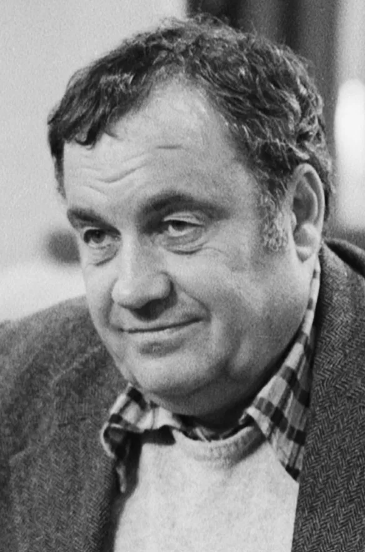
Ryazanov frequently wrote or co-wrote his own screenplays, most notably in collaboration with playwright and screenwriter Emil Braginsky. Their partnership was central to his success: Braginsky’s sharp dialogue and Ryazanov’s instinct for character and rhythm produced films that felt natural and were also extensively quotable. Writing his own material gave Ryazanov greater control over tone, meaning, and most importantly character development. It enabled him to produce plots that, even when bewilderingly far-fetched, remained, at the same time, believable. Further, he could embed subtext, irony, and ambiguity that might have been cut under stricter oversight.
Like many iconic directors, he kept a close team of actors, writers, and composers that he often worked with to create consistent works. Andrei Myagkov, Andrei Mironov, Yuri Nikulin, Lyudmila Gurchenko, and Liya Akhedzhakova, for instance, starred in multiple films for him, often getting to show a wide range of acting ability playing diverse characters. His collaboration with composer Andrei Petrov also leant his films an important emotional and narrative element, with many songs becoming cultural artifacts in their own right.
Ryazanov’s relationship with Soviet authorities was complex but largely pragmatic. Ryazanov’s father had spent 13 years in a gulag after being accused of “anti-revolutionary activities.” Ryazanov was careful not to position himself in open opposition.
A defining feature of Ryazanov’s cinema was his focus on the “little person,” a tradition rooted in Russian language literature from Gogol onward. His protagonists are often modest professionals whose private decency clashes with rigid, impersonal systems that often foster cruelty and corruption. Films such as Beware of the Car, Office Romance, and Little Old Thieves gently but incisively expose the moral contradictions of Soviet life without overt political confrontation. Later films, such as the perestroika-era Cruel Romance, go still further in their criticisms as such criticisms became more acceptable. Yet, he always stops short of decrying the entire system and never advocates for its replacement. Much of his criticism is couched in light humor and often masked with Aesopian narrative, placing the moral in what can be seen as a metaphor.
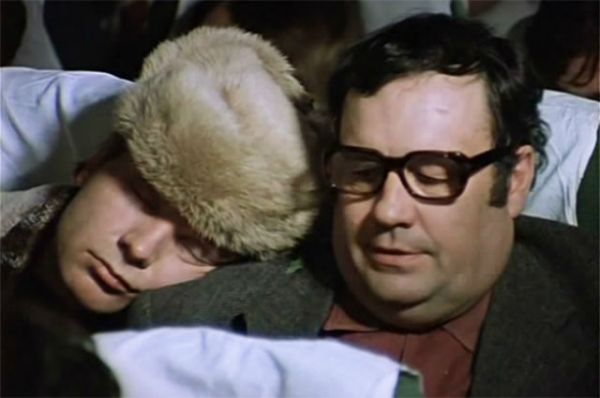
That said, no artist in the USSR was immune to censorship and Ryazanov received criticism and faced delays and script revisions. The Irony of Fate for instance, was criticized for its “unheroic” and “anti-family” heroes, who remain unmarried and childless even though they are beyond thirty years of age. Unbelievable Adventures of Italians in Russia, originally written by Ryazanov but shelved by the studio, was later changed by the authorities to the point that it was nearly unrecognizable. Ryazanov, seeing it in its new form the first time, expressed regret that someone would have to direct such a piece. Then he was told to direct it himself, which he reluctantly did.
Ryazanov had only one film expressly banned. His The Man from Nowhere (Человек ниоткуда), made in 1961, features a “savage” (played by comic actor Sergei Yursky in black face), who is brought to a near-future USSR. He sees flying cars and technological progress, but also proves more moral and reasonable than many of the citizens he meets. Mikhail Suslov, who headed Soviet ideology in the 1960s, criticized the film publicly and directly, after which all copies of the film were pulled from theatres. It would reappear in 1988 but today is a largely forgotten film.
Ryazanov experienced few additional repercussions from the official wrist-slapping. In his own words, he continued to be the recipient of the “merciful favors of fate,” and was allowed to keep making films that he felt he could be proud of.
In later years, Ryazanov remained an active cultural figure, writing memoirs, poetry, and essays while reflecting critically on both Soviet and post-Soviet realities. He is remembered not only as a filmmaker but as a moral voice. His films endure because they are undeniably humorous but also have emotional and intellectual depth, capturing the elements of life that could be cherished and those that had to be endured.
Carnival Night – 1956
(Карнавальная ночь)
Carnival Night captured the optimism and youthful energy of the Khrushchev Thaw at the very moment it began. A classic Soviet musical comedy, it follows a group of young people at a Soviet House of Culture trying to stage a fun, vibrant New Year’s Eve talent show, while their recently arrived, pedantic, and bureaucratic director, Serafim Ivanovich Ogurtsov, attempts to turn it into a stiff, boring, serious event. The film contrasts social rigidness with spontaneity, creativity, and generational change through a light, fast-paced musical comedy. Lyudmila Gurchenko’s star-making performance embodied a modern, self-confident femininity that sharply differed from earlier Stalin-era screen ideals. Its songs, composed by Anatoly Lepin became instant hits and helped define the film’s festive spirit.
Beware of the Car – 1966
(Берегись автомобиля)
Little Old Thieves – 1971
(Старики-разбойники)
In Little Old Thieves, two friends, a detective and an engineer, both nearing the sunsets of the careers, decide that they needn’t be forced into retirement as they both feel they have many years left to give. However, the detective faces a young upstart who has used his connections with “higher-ups” to force the detective out and secure himself as the impending replacement. The detective’s supervisor gives the detective one month to prove himself by solving a major crime. As there is no major crime to solve, the detective and engineer conspire to stage one themselves. After several mishaps, they are successful, but then get robbed themselves and are unable to identity or find the actual criminal. The detective sells all his belongings, but is not able to make up the sum and ends up arresting himself for the crime. In the end, he walks away, but one is left with sense that the system he faced is still unfair, and the film’s gentle absurdity is thus blended with pointed social critique, a hallmark of Ryazanov.
The film stars Yuri Nikulin and Yevgeny Yevstigneev, two icons of Soviet comedy. Perhaps ironically, they were only 45 and 50 at the time and had to be aged by makeup artists. However, their chemistry anchors the story with warmth and melancholy. Beneath the farcical premise and plot lies a sharp commentary on ageism, institutional rigidity, and the quiet tragedy of being declared useless by the very system one has long served.
Unbelievable Adventures of Italians in Russia – 1974
(Невероятные приключения итальянцев в России)
This film was almost never made. The script, by Eldar Ryazanov and Emil Braginsky, was originally titled “Spaghetti Po-Russki” and submitted for studio consideration in 1970. It was rejected as too slapstick and because all Italian characters were portrayed as gangsters; the USSR worried that this might hurt their currently friendly relations with Italy. However, when an Italian studio came into debt to Goskino, the main studio of the USSR, the script was heavily redacted and then approved by the studio. Although Ryazanov felt the script was nearly unworkable, he was appointed as its director. The drama continued with the Italians under-budgeting nearly every aspect of their contributions including in casting many previously unknown actors to the project.
In the end, the movie flopped in Italy, where viewers found it pointless slapstick that felt too “foreign.” It became the fourth biggest hit for 1974 in the USSR, however, for precisely the same reason. The presence of the Italians and the on-location Italian sets in some scenes felt exotic and cosmopolitan. The slapstick humor was rare at the time for the USSR although it was known to be popular in the US, which made the film even more unique for Soviet audiences.
Eldar Ryazanov considered the film to be one of his weakest, an eccentric comedy without much social subtext or psychological depth. The production was fraught with production difficulties, including working with the often inexperienced Italians, thin budgets, and what Ryazanov called a “sleepy, good-natured, and lovable” full-grown lion that appears in many scenes and often refused to obey the director or even its trainer and which terrified most of the actors. According to those that knew him, Ryazanov did not carry fond memories or opinions of the film. It did, however, become a lasting and unique cultural icon in the USSR.
The Irony of Fate, or Enjoy Your Bath! – 1975
(Ирония судьбы, или С легким паром!)
The Irony of Fate, or Enjoy Your Bath! draws upon both ancient Russian tradition and Soviet monotony to build a highly unlikely story of chance of love. Those unfamiliar with the culture and landscape can find distractingly far-fetched, but those within it are willing to accept the premise.
The film opens with the male lead in a banya with his friends on New Year’s Eve. Both the banya and New Year’s are regarded as particularly magical in Russian folklore. By accident and luck, he is mistakenly taken to the airport afterwards and, heavily intoxicated from the New Year revelry, is guided onto a flight by well-meaning strangers. Arriving in St. Petersburg, he stumbles into a cab and gives his Moscow street address. Due to Soviet monotony, the address also exists in St. Petersburg, at a neighborhood that looks just like his own. Even his key fits the door, the apartment looks much the same as his, and he falls asleep on the couch only to be awakened by a young woman arriving home to prepare for a romantic celebration with her very strait-laced fiancée. Comedy and love ensue.
The performances of Andrei Myagkov and Barbara Brylska balance irony and sincerity, allowing the absurd premise to evolve into a believable emotional connection. Mikael Tariverdiev’s lyrical music and songs, became inseparable parts of the film and hits in their own right. Today, the film is an important part of New Year rituals for Russian speaker and a lasting cultural touchstone.
A sequel was made in 2007 in which a similar situation happens to the children of main characters (who parted ways at the end of the original). Despite bringing back the original actors to play the parents, involving Ryazanov in writing, and securing one of Russia’s biggest directors, Timur Bekmambetov, to helm a picture filled with an all-star cast, it failed to reignite the magic of the original.
Office Romance – 1977
(Служебный роман)
The Garage – 1979
(Гараж)
Say a Word for the Poor Hussar – 1981
(О бедном гусаре замолвите слово)
Say a Word for the Poor Hussar is a Soviet musical comedy-drama set 20 years after the 1812 Patriotic War. The officers of a hussar regiment in a provincial town are tested for loyalty by a St. Petersburg official, Count Merzlyaev. To do so, Merzlyaev stages an elaborate ruse, accusing an actor in a theater troop of conspiracy and “free-thinking,” and planning a fake execution with blank cartridges. The plot turns south when a young, naïve soldier frees the actor, not due to conspiracy, but because the soldier is in love with the actor’s daughter.
The film, with an original screenplay by Eldar Ryazanov and Grigori Gorin, delivers a subtle but pointed reflection on honor, conformity, and moral courage. Oleg Basilashvili’s performance as the principled but vulnerable hussar anchors the film, while the ensemble cast embodies familiar Soviet social types disguised in period uniforms. The theatrical structure and ironic tone align with a broader Soviet tradition of “Aesopian language,” allowing sensitive ideas to pass through metaphor. Music and song play a strong role in the film, with many songs based on poems from famous Russian poets, including Denis Davydov, Pyotr Vyazemsky, Marina Tsvetaeva, and Mikhail Svetlov.
A Railway Station for Two – 1983
(Вокзал для двоих)
This complicated love story was the biggest hit of 1983 in the USSR. Platon, a pianist, is on temporary release from a penal colony where he is serving a sentence for running over a pedestrian. He confessed to the crime to save his wife from prison. While enroute, he meets Vera at a provincial railway station, where she works as a waitress. By the end, it is found out that Platon’s wife, a beautiful but haughty weather presenter on television, is no longer interested in him, despite his sacrifice. Throughout the film, Platon is humiliated and forced into nearly every action he takes. The only sense of justice that emerges is that Vera is revealed as his true love.
The performances of Lyudmila Gurchenko and Oleg Basilashvili are central to the film’s success, presenting love not as romantic escape but as ethical commitment under pressure. Nearly every authority figure shown is self-interested and cruel, meaning that the film can be seen as a social critique that shows private connections as the only salvation from an unjust public bureaucracy, a situation that many in the USSR were familiar with. The film’s blend of comedy, melodrama, and social realism aligns with Ryazanov’s broader body of work, as does its highly effective use of music, which again saw collaboration with composer Andrei Petrov to develop a soundtrack that supported and elevated the film to a long-remembered cultural icon.
A Cruel Romance – 1984
(Жестокий романс)
During the 1970s and 1980s, the Soviet Union experienced a significant trend of “prestige” literary adaptations, characterized by high-budget, faithful, and often multi-part television or cinematic renderings of classic Russian and foreign literature. Officially a campaign to bring culture and education to the masses, it also served as a form of cultural escapism during the period Brezhnev stagnation. It can also be seen as an attempt by the faltering state to appear still capable of monumental works.
As part of this, Eldar Ryazanov, most known for his satires focused on modern life, was tapped to film A Cruel Romance, an unusually serious, tragic costume drama. An adaptation of tsarist-era playwright Alexander Ostrovsky’s Without A Dowry. The result was a visually rich, emotionally resonant film with powerful performances by Nikita Mikhalkov, Andrei Myagkov, and a resounding debut role for Larisa Guzeev. It embodied enduring social themes which often pushed by the authorities but also could genuinely resonate with audiences such as class inequality, commodified relationships, and the limited agency of women. Andrei Petrov’s romance-style score, frequently praised in reviews, became inseparable from the film’s emotional impact, reinforcing its lasting cultural status.
You’ll Also Love

Films of Eldar Ryazanov, Moral Voice of the USSR
Eldar Ryazanov is remembered as one of the most influential and beloved directors in the post-Stalin Soviet era. Phrases from his movies, which is often co-wrote are still quoted by Russians as much as pieces of folk wisdom as pop culture references. He is best known for light comedies that also delivered social reflection, moral […]
Aleksei Balabanov and His Films: Cult Classics of Post-Soviet Russia
Aleksei Balabanov is one of Russia’s best known directors of the 1990s and his movies are known for capturing the essence of those turbulent years. Below is brief biography for him and several synopsis and reviews of his work, with links to watch them in the original Russian on YouTube. Balabanov’s Education and Early Work […]

You’re Next: The Cold War in American Horror Films
During the second half of the 20th century, Cold War anxiety and paranoia played out on America’s silver screens via the explosively popular horror genre. These films both reflected and shaped how Americans understood the perceived threats of a rapidly changing world. This paper examines five horror films—Them! (1954), Invasion of the Body Snatchers (1956), […]

Russian Language Horror Films
Although Russian folklore teems with fearsome spirits and creatures, horror has never taken root as a popular genre in Russian culture. In literature, the supernatural typically inflicts psychological rather than physical torment, and modern attempts at slasher horror in film have largely failed at the Russian box office. The most successful Russian horror films instead […]
The Best Soviet Films According to Soviet Citizens
In 1925, Sergei Eisenstein’s film Battleship Potemkin was released in the Soviet Union. At the time, it was regarded as one of the most important works in the history of cinema, and still often appears on lists of the world’s greatest films. However, only in 1958 did independent film ratings in the USSR appear, when […]
