

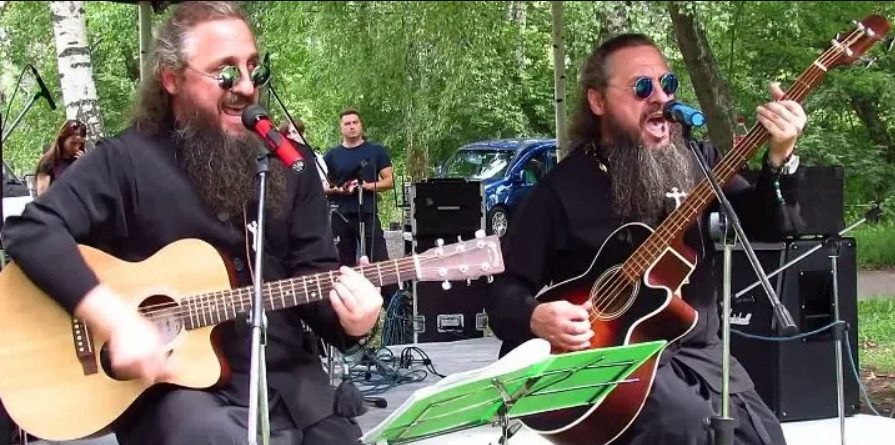
Orthodox song (православные песни) is a unique genre of Christian music that draws upon the traditions of the soviet bards, estrada, and sung poetry popular in Russia and Eastern Europe. Sung by both laity and “priest-bards,” the music experienced rising popularity in the decade following the fall of the USSR as religious affiliation surged in many former Communist states including Russia. In the past decade, however, development of the genre has stifled as Russia’s religious landscape has shifted.
The following resource will examine Orthodox song and introduce a few of the major artists who have contributed to its development. It will also explore how theology, identity, and changing ecclesiastical and legal norms have affected the trajectory of this and other Russian-language Christian musical genres.
Defining Orthodox Songs
In the US, religious hymns can be very similar to Christian popular music to the point of having one substituted for the other in church services. However, the two styles in Orthodoxy are quite different and definitely not interchangeable.
Music used in church services is liturgical and often referred to as “Orthodox chants” (православные песнопения). These are delivered in Church Slavonic and strictly sung a cappella, such as shown in these examples. Liturgical music, in Orthodox theology, is not considered “performative.” It is instead a form of prayer, a way of conveying a sacred text that provides a meditative “state of soul” conducive to receiving divine grace.
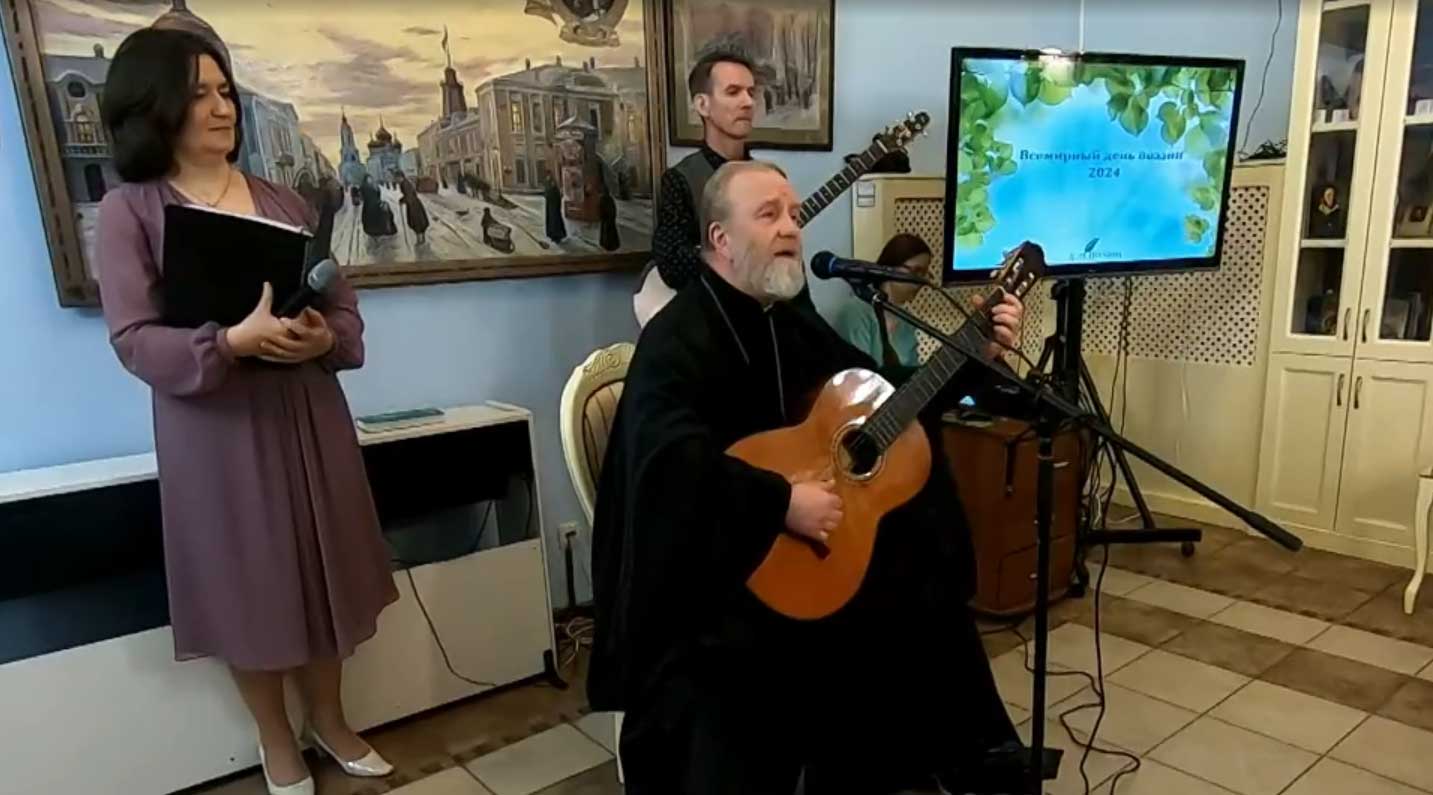
Orthodox songs, meanwhile, are sung in modern Russian. However, the focus remains on the words with the most defining aspect of the songs being their expressly Christian, often proselytizing, messages. They typically carry a moral lesson, often delivered through allegory. Sometimes the songs, like liturgical chants, take the form of prayers, including those asking a saint for intercession. Sometimes the songs simply convey the singer’s personal faith.
Instrumentation can be diverse but is always arranged so that the focus is on the singer and the words. Various influences from popular genres can be felt. Like the Soviet-era bards, the music tends to feature personal and philosophical lyrics. Like sung poetry, an influential style popular across much of Europe, the lyrics tend to be literary and often narrative. In both of these examples, the singer is often only accompanied by a guitar, although this is not definitive so long as the singer’s message is clearly heard. Other examples of Orthodox song draw from estrada, a pop genre partly developed from opera, which can have extensive instrumentation, and relies on the power of the singer’s voice to stand out.
What to call “Orthodox song” is not an entirely settled issue among its artists. Some artists refer to their music as “Christian songs” (христианские песни), while some use “bardic songs” (авторские песни), “christian bardic songs” (авторские христианские песни), “church songs” (церковные песни), or “spiritual songs” (духовные песни). However, “Orthodox songs” (православные песни) is a widely used term, especially on YouTube channels and playlists. It is also most precise to the Russian Orthodox context and more inclusive of the wider musical styles used. For the purposes of this resource, we are using “Orthodox song.”
Also blurring the definition of the genre is the fact that musicians are seldom specialized in it. Those that are fully specialized have often been members of the clergy who make singing part of their religious mission. Most representatives, especially today, are professional musicians that operate across a range of genres.
Liturgy, Bureaucracy, and Barriers to Development
Within Orthodox theology, the Church is understood to exist outside of time: all past eras must remain spiritually present within it. As a result, any proposed new practice or innovation must be carefully measured against established tradition. In practice, this has produced a strongly conservative top-down institutional culture that prioritizes conformity with earlier teachings and customs. The activities of parishes, clergy, and church-affiliated organizations are strictly regulated to avoid any perception of contradiction.
During the comparatively open and philosophically minded patriarchate of Patriarch Alexy II, the Church actively encouraged Orthodox song as a form of missionary outreach after decades of Soviet repression. Numerous festivals were organized under church auspices, and “priest-bards” became highly visible figures in post-Soviet religious culture.
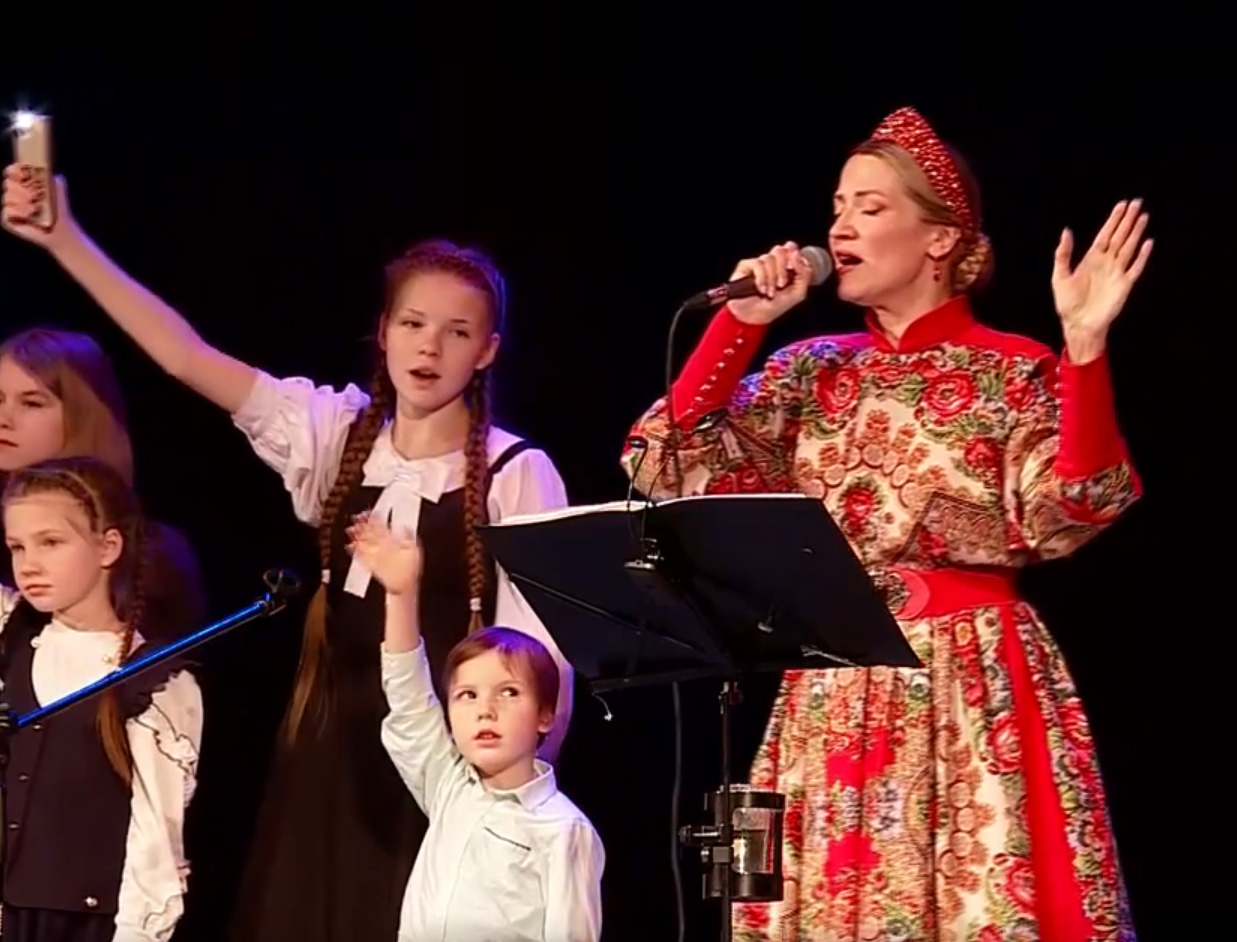
However, there has always been debate over which and even whether secular music forms should be supported by the Church. An even wider debate formed over what subjects could be covered, especially among the laity, considering the highly regulated theology of the church. Yet another debate eyed the commercial marketing efforts and personal followings of performing clergy and how it might affect church hierarchy and create perceptions of clergy as prideful and using their positions to gain profit.
Although no formal pronouncement was made, under the far more conservative reign of Patriarch Kirill, the “priest-bards” of the 1990s and 2000s gradually stopped releasing albums, abandoned personal websites and often even social media, and reduced their public creative activity. Performances still occur, but recordings are now more often uploaded by fans or local media than by the artists themselves. Festivals have also become fewer and more tightly controlled.
The conservatism of Russian laity has also contributed to today’s religious landscape. This conservatism extends deep into the culture, placing anything seen as “Orthodox” squarely within the purview of the church hierarchy. As one striking example can show, even major holidays such as Christmas and Easter have remained entirely spiritual, non-commercialized Church holidays for Orthodox Russians, celebrated much as they were centuries before.
That said, the relationship of parishioners to the church is changing, especially with the polarization that has occurred with the Orthodox Church’s openly political stances. Patriarch Kirill has actively supported Vladimir Putin, characterizing his rule as a “miracle” that brought stability after the 1990s. Since 2022, Kirill has framed the war in Ukraine as a holy war against both fascism and liberal secular values. Some clergy and believers strongly support these stances, others have protested. Meanwhile, some – but not all – Orthodox musicians have adopted similar themes in their work, and all official Orthodox song festivals now include military bands and fundraising for the military. As can be expected with polarizing issues, recent polls have shown that a falling number of Russians identify with the Church, but those who do attend are now attending more fervently.
Thus, Russian Orthodoxy is most often a declarative part of Russian identity, but not an active part of a lifestyle that would likely drive consumption of Orthodox-themed music. However, for a growing minority, it is a lifestyle choice and may represent a source of a smaller, yet more passionate, market.
Lastly, Russian law has helped enshrine church conservatism with Article 148 of the Criminal Code, which imposes up to three years imprisonment for “public actions that insult religious feelings.” While this apparently has not been used against practitioners of Orthodox song, it has been used against other secular musicians. For instance, the Russian metal band Batushka, has been sued by the Orthodox Church, which points to the band’s name, a widely-used although informal and affectionate name for a church official, and its controversial lyrics which the Church has deemed heretical. While an extreme case, it does still point to a certain amount of ecclesiastical and legal risk in using religious themes.
The “Priest-Bards” of Orthodox Songs
Orthodox clergy once played a leading role in Orthodox song. From the spiritual a cappella singing Hieromonk Roman Matyushin to the rock stylings of Protopresbyter Oleg Skoblia, these artists combined ministry with songwriting and public performance, often presenting their music as an extension of preaching, confession, or missionary outreach. Most, however, have faded from publicly promoted view although some are still performing.
Hieromonk Roman Matyushin
Hieromonk Roman Matyushin, often known simply as “Father Roman,” was born in a small village in 1952. He began writing poetry in his youth and took monastic vows in 1980. Over time, he became one of the most celebrated poets in contemporary Orthodoxy, publishing more than thirty books of poetry and spiritual literature, most through church presses. His works have received honors both within and outside the Church, including directly from the Patriarch. They have been translated into languages including Serbian, Bulgarian, and Polish.
Father Roman is also known for singing his own poetry, usually a cappella or with very minimal instrumental accompaniment. He has released over a dozen albums, along with several collections, many also published under church auspices. He does not recognize copyright, however, believing his works exist for God’s glory and should freely help bring people to faith. Numerous artists, including Zhanna Bichevskaia and Oleg Pogudin, have performed his songs, sometimes devoting entire concerts or albums to his work.
One of his best-known songs is “Слава Богу, снова я один” (“Thank God, I Am Alone Again”), which reflects on solitude, communion with God, and simply being in and working within the beauty of the natural world. The song features subtle guitar accompaniment that is often less noticeable than the sounds of birdsong and scraping shovels, which become part of the musical atmosphere. The most striking feature of all Father Roman’s songs is his calm, prayerful voice.
In 2012, a documentary about his life and work, Русь ещё жива (Rus Is Still Alive), was released and remains freely available on YouTube.
Archpriest Sergey Grigorovich Kiselyov
Father Sergii Kisilev is a priest with the Ukrainian Orthodox Church, songwriter, and performer born in Kyiv in 1958. Ordained a priest in 1990 and later elevated to the rank of archpriest, he serves at the Church of the Meeting of the Lord in the village of Sulimivka in Kyiv Oblast.
Father Sergii’s style is heavily influenced by Soviet bards. While his voice stays smooth, his staccato guitar accompaniment, narrative rhythm, and vocal inflections are reminiscent of Vladimir Vystosky. His concerts are often referred to as “sermons in song,” since his music combines warmth and accessibility with direct contemplations of conscience, repentance, faith, and the spiritual struggles of everyday life. Many of his YouTube videos, in fact, combine theological discussion paired with a song that illustrates its lesson.
Song was long a part of Father Sergii’s ministry and, with the blessing of the Church, he often gave concerts at prisons, halfway houses, and hospitals. He described his work in the following way: “I try to write for people who don’t go to church, don’t read the Holy Scriptures, and don’t know God. The main goal of my work is for a person to hear the song first with their ears, then with their heart, and then want to come to church.”
He won first place in the singer-songwriter category at the St. Petersburg Art Song Festival in 2005 and was once regularly featured on the Soyuz Orthodox television channel, which is based in Yeketerinburg. He often toured in Ukraine, Russia, and even to diaspora populations in Germany. He performed solely in Russian.
Father Sergii’s public music career seems to have ended in 2022, with the start of the war with Russia. The war sparked a movement to move away from Russian language usage. He continues his work in the church, his channel remains online, and his videos are available and still watched from multiple sources. However, his last personal posts were made and concerts given in February, 2022.
Protopresbyter Oleg Skoblia
Born in 1963 in the city of Korosten in Soviet Ukraine, Oleg Skoblya originally trained as an actor at the Leningrad State Institute of Theatre, Music, and Cinematography. He pursued an acting career before being conscripted into the Soviet military. Upon the end of his service, he entered the Leningrad Theological Seminary, eventually being ordained in 1990. He later became rector of the historic Church of Saints Simeon and Anna in St. Petersburg, one of the city’s oldest active churches.
Although he left acting, Father Oleg retained his performative skills and released nine albums. His style is sometimes referred to as “Orthodox rock,” with the accompaniment of often soaring electric guitars and prominent drums. His voice is passionate and frequently rough, with songs arranged in rock ballads and sometimes even bordering on heavy metal. His voice is always above the music, however, with the Christian message clearly conveyed.
Many of Father Oleg’s best-known works focus on repentance, spiritual warfare, suffering, sacrifice, and the search for God amid the moral confusion of modern life. Singer Zhanna Bichevskaya, who has performed many of his songs on stage, says of his music that “these songs are confessional sermons. You believe him.”
Of his own work, Father Oleg says that “The soul begins to respond to God’s call, which is clearly heard in the songs. The soul gradually awakens, as if from hibernation, and the act of its awakening from mortal sleep is akin to an act of resurrection and, if you will, its holy spring.”
Although perhaps most remarkable for his hard-rock influences, many of his most popular songs remain those that are softer and more prayerful such as “A Tear Runs Down The Icon” (“По иконе катится слеза”), “The Bells Are Ringing” (“Звонят колокола“), and “A Lonely Cry” (“Одинокий крик”).
Father Oleg is also a published author of poetry (including a book of his song lyrics) and books answering common questions about Orthodoxy in simple question-and-answer formats.
Although he occasionally still performs and his music remains popular, Father Oleg stopped publishing new music in 2014. His entire music library remains online and influential.
Archpriest Gennady Ulyanich
Archpriest Gennady Ulyanich began his musical education at the age of seven, studying accordion at the music school of the Khimvolokno Cultural Center in Tver, Russia. He later became a dental surgeon, graduating from the Tver Medical Institute in 1986. He also sang avidly in church choirs and was active in church life.
Eventually, he pursued a theological education, was ordained and, in 1998, became rector of the Church of St. Joseph of Volotsk in Sakharovo near Tver.
A year later, he began collaborating with composer Natalia Balashova to create a large body of spiritual songs based on the poetry of Orthodox priests and monastics such as Archpriest John Basyuk and Monk Vsevolod Filipyev. These performances, which Father Gennady describes as вокальных проповедей (“vocal sermons”), combined Orthodox spirituality with a simple estrada style that emphasizes vocal range and gentle melodies. He sometimes plays accompanied by his guitar, a piano, or pre-recorded track.
He intended his style, like liturgical music, to allow listeners to enter meditative states while listening to spiritually beneficial messages. He later combined his passions for science, art, and religion by partnering with researchers at Tver State University to show that his music has measurable therapeutic effects and could raise mental functioning and creativity.
His style was also remarkable in that it resembled some of the softer examples of shanson, a musical genre specifically associated with Russia’s criminal underworld. As Father Gennady toured Tver, he caught the attention of Mikhail Krug, another Tver native and one of the biggest names in Russian shanson of the 1990s. Krug produced, with the blessing of the Church, Father Gennady’s first solo album, Spiritual Songs, in 2000-2001.
Father Gennady expanded his tours to Chechnya, Moscow, St. Petersburg, and Voronezh. His concerts frequently blend music, pastoral reflection, and psychological discussion.
He still performs avidly and his songs can be found scattered across the internet. One of his latest efforts is a new album called From Where is This Beauty (Откуда эта красота), released on Apple music in 2024. However, he runs no personal website or social media accounts to promote his work.
Professional Lay Musicians of Orthodox Songs
Lay performers are often professional or semi-professional performers who may or may not have direct support from or connections to the Orthodox Church’s formal hierarchy. Many have theatrical backgrounds and training. These artists perform in a variety of styles and cover an array of themes. Avenues of self-promotion also vary, with social media the most common and personal websites much less so. On political issues, they have tended to either be vocally supportive of state positions, or silent on political and military issues.
Zhanna Bichevskaya
Zhanna Bichevskaya attended the State Circus and Variety Arts School before emerging in the 1970s initially specializing in arrangements of Russian folk songs presented with a unique country twang. She was mentored early on by one of the founders of the Soviet bardic movement, Bulat Akudzhva, who consistently praised her professional and passionate reworking of songs, including his own.
During the late Soviet period and especially after the collapse of the USSR, Bichevskaya increasingly turned toward Orthodox Christianity as well as patriotic and nationalist songs. Over time, her work has also espoused increasing monarchist, nationalist, and militarist themes, presenting Orthodoxy, Russian historical continuity, traditional culture, and military glory as inseparable elements of national identity. Much of her music is both simple yet also features polyrhythmic times, much like in the ringing of Orthodox church bells.
A major part of Bichevskaya’s later work involved popularizing the songs and poetry of Orthodox clergy and monastics. For instance, she released an entire album to Hieromonk Roman Matyushin. Although her performances preserve the importance of the message, they include considerably more instrumentation than Matyushin’s simple originals.
Over her career, she recorded nearly 50 albums and has given hundreds of concerts and TV performances. Her website prominently displayed on its homepage her dispensation from Alexy II to create “spiritual music.” However, that website was taken offline in 2023 and the only social media accounts that now bear her name are run by fan clubs.
Throughout the 1990s and 2000s especially, Bichevskaya performed extensively across Russia, Eastern Europe, and among Russian émigré communities abroad. Her concerts often took place in cooperation with Orthodox cultural organizations, patriotic associations, and church-related events. Now in her 80s, she continues to give occasional concerts, and her music remains foundational to Orthodox song. She was named People’s Artist of the RFSFR in 1988.
Svetlana Kopylova
Svetlana Kopylova is a Russian singer-songwriter, actress, and poet. Born in Irkutsk in 1964, she initially pursued a career in acting and graduated from the Boris Shchukin Theatre Institute in Moscow. During the late Soviet and early post-Soviet years, she appeared in film and theater productions before increasingly dedicating herself to songwriting and Orthodoxy.
Kopylova is best known for her “parable songs” (песни-притчи). One of her most popular examples is “A Paintbrush in the Hands of God” (“Кисточка в Божьих руках”), the title track to her fourth album and second completely devoted to the form. The song tells a story using the common Christian metaphor that emphasizes that man must consider himself only a tool of God rather than to seek glory for himself.
Kopylova first became widely known in musical circles through collaborations with prominent Russian performers and writing songs for Soviet films. Over time, however, Kopylova increasingly performed her own pieces, with her theatrical and narrative style heavily influencing her work. By the early 2000s, Orthodox Christianity had become a defining focus of her work although among her nearly two dozen albums she has others devoted to “history songs,” “legend songs,” and “ballad songs,” mostly drawing from Russian history and folklore.
The stories told in Kopylova’s songs tend to be vehicles for presenting simple morals rather than didactically espousing theology or nationalism. For instance, “Seeing Love” (“Зрячая любовь”) tells of a man cured by Jesus of life-long blindness. However, the main character of the story is the healed man’s wife who, learning of the news, fears her husband will no longer love her as she is not beautiful. The song ends with the two more in love than ever and the true miracle, it seems, is the love and devotion between the man and wife.
The popular song “About a Frog” (“Про лягушек”), on an album devoted to stories about Russia Tsars, features Alexander II reprimanding the pride of a French Ambassador who insults Russian cuisine.
Kopylova has performed widely throughout Russia, Belarus, Ukraine, and among Orthodox communities abroad. Her concerts frequently took place under the auspices of the Church, and she has been awarded with multiple medals and awards by Russian Orthodox Church organizations.
Svetlana Kopylova runs two very active YouTube channels (one for her music and another devoted to her theater activity) and other social media pages. Her personal website, however, has not been updated since 2021. Kopylova is remarkable in that she seems to have avoided addressing the war in her work. In terms of streaming, she is one of Russia’s most popular Orthodox song artists today.
Pavel Fedosov
Pavel Fedosov is a young but very active artist and Orthodox activist. In addition to singing and songwriting, he heads volunteer projects for the St. Andrew the First-Called Foundation and is especially known for giving concerts in prisons, hospitals, and orphanages. He also has been heavily involved with the Confession of the Heart Orthodox Song Festival, held annually in Kostroma, just outside of Moscow.
He holds a degree in philosophy from Moscow State University, where he was also heavily involved in experimental theatre. He credits his musical style to influences such as the “psychedelic blues” of Yuri Naumov and Soviet rock such as the band Aquarium.
Speaking with Radio Vera, Russia’s Orthodox Christian talk radio network, he describes his music as a transcendent addition to his volunteer work. He calls it a time when he can make a personal connection with residents who are often confined to their living spaces which allows walls to “fall away” for a certain time.
Fedosov’s music often tells the stories of those he’s met or from his own life, and can take the form of prayers to saints. Most, however, are simply about finding purpose in life through God. For instance, his most popular songs such as “Doves” (“Голуби”), “No Other Life Will Begin” (“Никакая другая жизнь не начнется”), and “Don’t Fear. I’m with You” (“Не бойся. Я с тобой”), all carry the message that accepting faith can help a person overcome depression and anxiety.
Fedosov has no personal website, but does maintain an active YouTube channel and a VK social media page. He continues to tour, participate in festivals, and perform charity concerts.
Yuliya Slavyanskaya
Yuliya Slavyanskaya was born in Perm in 1970 and raised in Sergiev Posad near the Trinity Lavra of St. Sergius. She grew up in a family deeply connected to music, literature, and Russian cultural traditions. Her father, a physicist and military officer, and her mother, a biologist, both loved bard songs, romances, and folk music. Family gatherings often included performances of military and patriotic songs, while her mother sang in the folk ensemble “Moskoviya.” Living near one of the spiritual centers of Russian Orthodoxy also strongly shaped Slavyanskaya’s religious worldview from an early age.
Slavyanskaya received formal musical training from childhood and later graduated as a choral conductor from the Prokofiev Music College in Pushkino. She subsequently studied acting at the prestigious GITIS institute in Moscow. Among her early influences were Soviet estrada singers and bard performers, especially Alla Pugacheva, alongside Russian folk traditions and Orthodox church singing.
Although best known for spiritually themed songs centered on faith and family, Slavyanskaya is also very well known for her arrangements of Russian folk and creation of pieces based on classic Russian poetry. One of her most popular pieces, “We are Drawn to Those Who Love Our Souls” (“Нас тянет к тем, кто душу обнимает“), which focuses on love and forgiveness, is based on a poem written by Alexander Tuganov, a Tsarist-era poet. Another popular piece, “Lament for Mary” (“Плач Марии”) is a translation of the oldest known poem in Hungarian, which imagines Mary’s emotions as she saw her son crucified.
However, by far Slavyanskaya’s best known songs are her most controversial. Since the beginning of the 2022 Russian invasion of Ukraine, Slavyanskaya has written a number of military-themed songs in support of the war. These, in particular, have glorified the Russian war effort and demonized the West and Ukraine.
The most striking of these military songs include “What Have You Done, Brothers?” (“Що ж ви, брати, наробили?“), which accuses Europe of having pushed the Ukrainians into starting the war in a scheme to get Orthodox Slavs to kill Orthodox Slavs. The title of the Russian-language song is in Ukrainian, making the song directly addressed to Ukrainians. Another song, “Letter of a Ukrainian Soldier” (“Письмо украинского солдата”) pictures that soldier writing home to his mother to tell her that he is a monster for having fought the war and to praise the Russians who captured him and are now taking care of him despite his sins as good, Orthodox Christians. The link video above shows the song aired on an Orthodox TV station in Russia, with accompaniment provided by an Orthodox priest.
Slavyanskaya maintains an active personal website and multiple social media accounts. She actively appears at festivals, on media broadcasts, and gives concerts in Russia.
Platforms for Orthodox Song
Infrastructure for developing modern Orthodox song is quite limited in Russia.
The best-known festival dedicated specifically to modern Orthodox song is Confession of the Heart (Исповедь сердца), held annually in the Kostroma region near the historic Ipatiev Monastery. One of Russia’s state newscasters gave an extensive report on the 2026 festival. However, other festivals, such as the Silver Psalter (Серебряная Псалтирь), formerly held each year in Dubna near the borders of the Tver and Moscow regions have ceased operations. Confession of the Heart has also opened its format to include military music as well.
Most church-sponsored music festivals instead focus on older and more traditional forms of Orthodox culture. Festivals such as Singing Angel (Поющий ангел) and Easter Voice (Пасхальный Глас) primarily emphasize choral singing traditions, while Origins (Истоки) highlights choirs and orthodox bell-ringing. More common still are mixed-format festivals such as Visiting Nikola (В гостях у Николы), The Domes of Arzamas (Арзамасские купола), and the Barysh Festival (Барышская фестиваль), which combine Orthodox-themed folk music with patriotic songs — often from the Soviet era — alongside choral performances and/or occasional appearances by Orthodox song singer-songwriters. Secular festivals focused on Slavic folk culture, such as The Sky of the Slavs (Небо славян), frequently feature similar repertoires.
Orthodox media infrastructure has also contracted since the 1990s and 2000s, largely due to funding issues. Today, the two major Orthodox radio stations remain: Radio Vera (Радио Вера) and Radonezh (Радонеж). Both focus primarily on talk programming, including discussions of theology and morality, dramatized lives of saints, and religious commentary. Music, most often classical, generally appears only as short interludes between programs, or as part of liturgical programs.
Similarly, two major Orthodox TV channels exist today: Spas (Спас) and Soyuz (Союз). Both focus mainly on news, religious education, and church affairs. Soyuz does carry extensive cultural news of the festivals and music described above and occasionally has practitioners of Orthodox song perform as guests.
This limited support for contemporary Orthodox music reflects the broader conservatism of the Russian Orthodox Church itself, as well as public expectations that Orthodox culture should preserve historical traditions rather than encourage innovation.
Conclusion: Faith as Inspiration in Russia
Today, Orthodox song is known primarily through streaming platforms and small concert performances in Russia. Its continued niche status may seem surprising at first, given that the genre draws heavily from musical traditions popular in Russia and addresses themes central to Russian cultural and religious identity.
Further, Christian themes are present in mainstream Russian-language popular music. The classic rock band Alisa, for example, has incorporated biblical imagery and religious themes into its music for nearly a quarter century. Other artists, such as Splean, have woven references to faith and spirituality into their songs in more subtle ways.
The key difference is that these artists place the emphasis on music and personal expression rather than religious instruction. Even Konstantin Kinchev, the deeply religious frontman of Alisa, describes himself only as a rock musician who writes about the subjects that matter most to him. While his songs often contain moral themes and biblical symbolism, they rarely feel as though they are preaching directly to the listener. This approach aligns more closely with both public expectations and the traditional Orthodox view that explicit spiritual guidance and religious teaching belong primarily to the Church hierarchy rather than to popular entertainers.
Thus, while there remains a niche market for Orthodox song, there is not a market for “Christian music” in Russia similarly structured to the market as developed in the US. This is precisely because of differing relationships between religion and music and due to differing relations of religious identity to lifestyle.
You’ll Also Love

The Red Elvises / Красные Элвисы
The Red Elvises (also known as Igor and the Red Elvises; or Красные Элвисы, in its less-frequent Russian form) is a Russian-American band that plays an eclectic mixture of rockabilly, reggae, folk, disco, funk, surf rock, and traditional Russian music. The band is based out of Los Angeles, but has had successful tours in Ukraine […]

Konets Filma / Конец фильма
Konets Filma (Конец фильма; “end of the film”) is a Russian rock band. Active since 1998, when it was founded by Russian natives of Estonia, it currently includes Evgeny Feklistov (Евгений Феклистов; vocals, acoustic guitar, songwriter), Pyotr Mikov (Пётр Миков; guitar), Aleksey Pleshchunov (Алексей Плещунов; bass guitar), Aleksey Denisov (Алексей Денисов; drums) and Stepan Tokaryan (Степан Токарьян; keyboards, backing […]

Okean Elzi / Океан Ельзи
Okean Elzi (Океан Ельзи—note that this is the Ukrainian spelling) is a prolific Ukrainian rock band from Lviv. Formed in 1994, they have released nine studio albums since 1998, toured extensively throughout Ukraine, Russia, the majority of Europe, and North America, and are heralded today as one of the greatest rock bands of the former Soviet […]

Max Korzh / Макс Корж
Max Korzh (Макс Корж) is a contemporary Belarusian rap/hip-hop singer. While most of his music is in Russian, he does have the odd song or video clip that includes some Belarusian. Korzh attended musical school outside Brest, Belarus, and founded his first band, LunClan, with some friends when he was 16. The band, along with his next […]

Bad Dogs / Złe Psy
Bad Dogs (Złe Psy) is a Polish rock band that’s been around since 1999. The name apparently refers to American pit bulls, for which Andrzej Nowak, its founder, has a certain fondness. Nowak also sings vocals and plays guitar in the band TSA. TSA, Nowak’s first major project, is a hard rock/heavy metal band that […]
