


Estrada is a musical style largely defined by its performance. Its stars are larger-than-life personalities who draw audiences into the show through expressive singing and direct engagement. Most often classically trained vocalists, they often have operatic ranges and typically perform songs written by professional composers and poets. Performances typically lean heavily on spectacle, with large backing bands or orchestras, elaborate costumes, and choreographed dancers.
The genre is also defined by its history. Emerging in the Soviet Union in the 1930s, it was initially built upon pre-revolutionary Russian variety theater and would eventually show strong influences from operetta, jazz, and big band influences. Some of this evolution would be driven by shifting popular tastes but also by state censorship of musical styles. Yet, the music would eventually outlive the USSR and remains a pop culture industry today.
The resource below briefly describes estrada’s early development then proceeds to introduce some of the most important stars of modern estrada, starting from the 1960s to the present day.
A Short History of Estrada
Despite the political and economic chaos that came with revolution and the fall of governments, estrada would remain a popular art form under the tsars, the soviets, and in modern Russia.
Origins of and Early Estrada
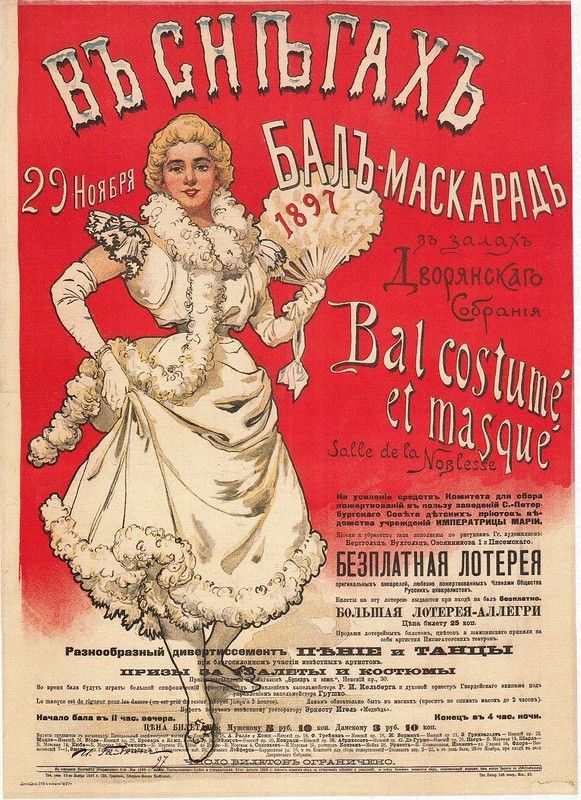
The roots of estrada run deep. The French word estrade originally referred to a raised stage, where a program would be held that often combined singers, actors, comedians, dancers, magicians, storytellers, and other entertainers in a fast-paced succession of short acts. Russian variety theater adapted this model (and borrowed the name) before the Revolution, placing greatest emphasis on popular songs, romances, folk music, comic sketches, and literary recitations, drawing on Russia’s own centuries-old folk traditions of traveling bards and entertainers. The Russian performances were often more dependent on individual charismatic entertainers who spoke directly to audiences, encouraged participation, and gave a sense of unity to the show.
After the Bolshevik Revolution, the Soviet government quickly nationalized theater companies. While dramatic theater became an important vehicle for political messaging, estrada was generally allowed to remain focused on light entertainment, romance, humor, and everyday life. Dedicated estrada theaters were established, and the genre, ever flexible, continued to absorb influences from modern international influences like jazz and big band.
By the 1930s, estrada had emerged as an official form of Soviet popular entertainment and, as the Soviet film industry arose, most early estrada artists became nationally known through films in addition to concerts and radio broadcasts.
Early Estrada Artists: from the Revolution Through WWII
Several early stars helped establish estrada in its modern form.
Leonid Utyosov (1895-1982) was perhaps the most influential. Born Lazar Weissbein to a Jewish family in Odessa, Ukraine, he had no training before joining Odessa’s theater scene as a teenager. First an acrobat, he became an actor, comedian, singer, and master of ceremonies, adopting the Russian-sounding stage name “Utyosov,” derived from the word for “cliff” (утёс). In 1917, he moved first to Moscow and then Leningrad, rising to national fame with the debut of his Tea-Jazz orchestra in 1929, which helped pioneer jazz in the USSR. He and his band would be featured in the blockbuster 1934 musical film Jolly Fellows (Весёлые ребята). Many of his best-known songs remained rooted in Odessa, including “Barges Full of Mullet” (“Шаланды полные кефали”), a love song set in Odessa and “By the Black Sea” (“У Черного моря“), a love song to Odessa. More risque songs included “From an Odessa Prison” (“С одесского кичмана”), which follows thieves escaping prison during the Russian Civil War, and “Song of the Old Cabby” (“Песня старого извозчика”) which has distinct Russian folk influences and comically deals of themes of drunkenness. Both of the latter also helped later define shanson, a genre that developed further in Soviet Gulags. With Stalin’s campaign against jazz, Utyosov would rename his band to the State Estrada Orchestra in 1947, toning down jazz influences, and bringing in more classical and folk structures.
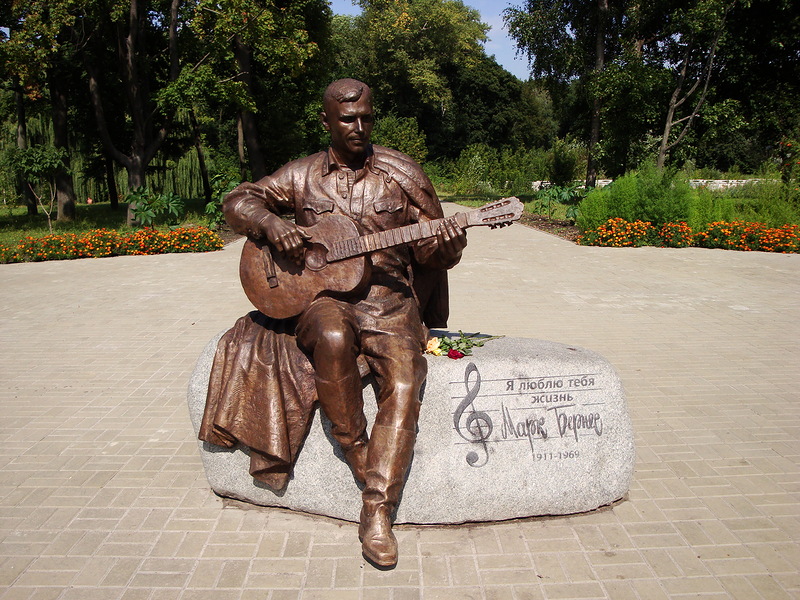
Mark Bernes (1911–1969) followed a similar path and became one of Utyosov’s chief rivals. Born Mark Neiman, he also lacked formal musical training, learning instead through theater in Kharkiv, Ukraine before adopting a less-Jewish-sounding stage name and moving to Moscow to work at the Maly and Bolshoi Theaters. His true fame came with film, and particularly for the songs he sang as an actor. An early hit, “The City Sky Grows Overcast” (“Тучи над городом встали”) in Man with a Rifle (Человек с ружьем) appeared in 1938. Bigger hits came with war-time performances, particularly in the 1943 Two Soldiers (Два бойца) in which he sang “Dark Is the Night” (“Тёмная ночь”). Shortly before his death, he released “Cranes” (“Журавли”). Based on a translation of an Avar poem, the song cemented the image of white cranes representing fallen soldiers in Russian culture. These two greatest hits were also mournful enough that they are still popular both as patriotic songs and anti–war songs.
Rashid Behbudov was one of the first artists to successfully mix non-Russian musical traditions to the growing estrada traditions. Born in Tbilisi to the prominent Azerbaijani mugham singer Majid Behbudov, he developed his skills in choirs, army ensembles, and, later, philharmonic orchestras. His breakthrough came with the 1945 musical film The Cloth Peddler (Аршин мал алан), a Russian-language film adaptation of Uzeyir Hajibeyov’s Azerbaijani operetta. Most of his lasting hits are in Azerbaijani, including “It Won’t Last a Year” (“Sene de qalmaz”) and “Today is the Third of the Month” (“Bu gün Ayın Üçüdür”). His Russian-language songs such as the popular “I Met a Girl” (“Я встретил девушку”), likewise retained unmistakable Azerbaijani melodic influences, helping broaden the musical vocabulary of Soviet estrada.
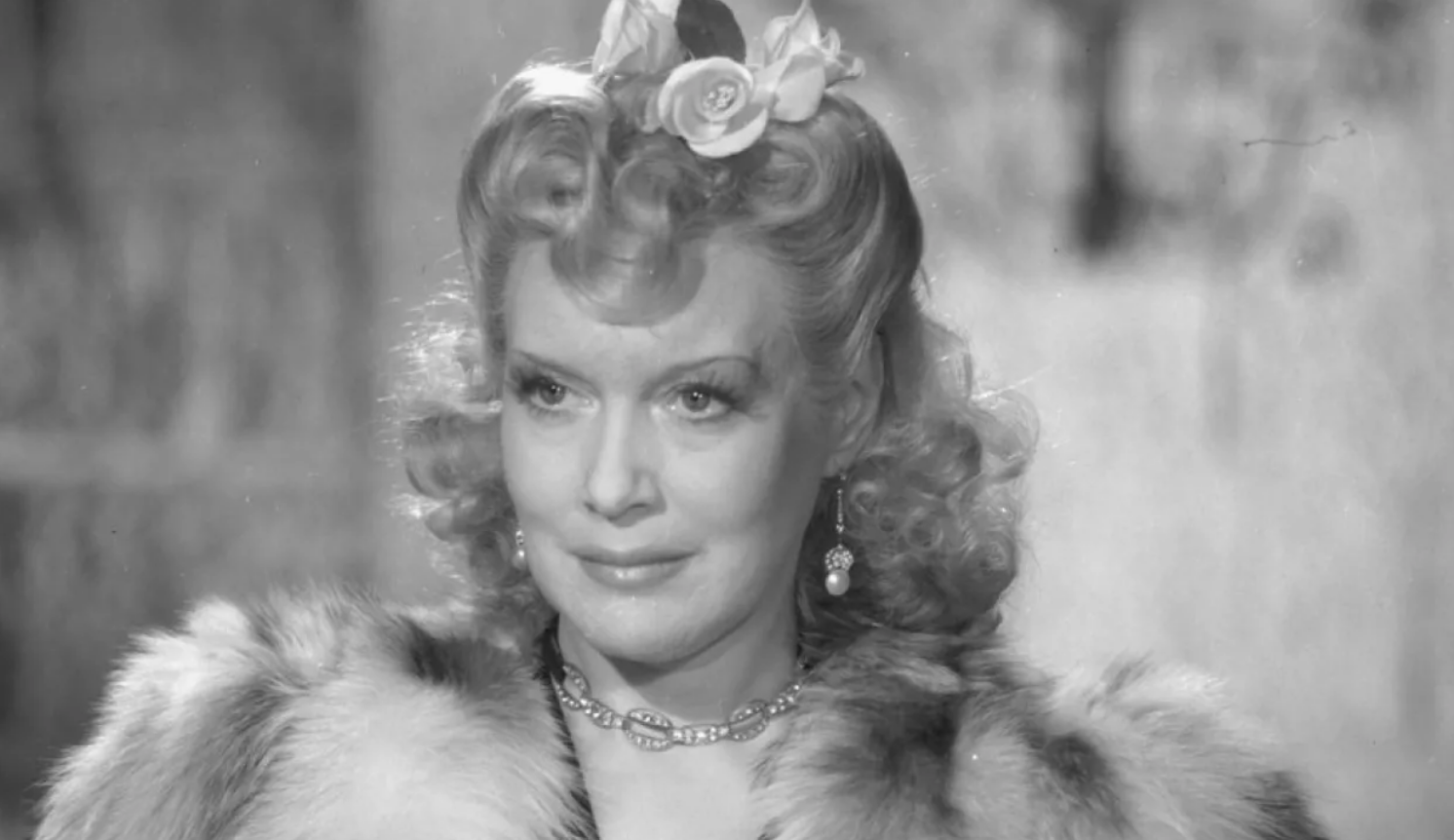
Lyubov Orlova (1902–1975) was born near Moscow into a noble family, received extensive musical training from childhood, and began her music career under the legendary Vladimir Nemirovich-Danchenko. Her first marriage, to a prominent Soviet economist, was undertaken in part to provide some stability to her wider family, left impoverished by the revolution. After her husband was arrested and executed just a few years later, she married film director Grigory Aleksandrov, and was cast in his musical comedy Jolly Fellows (Весёлые ребята). Despite a deep personal resentment of Stalin, she went on to star in patriotic classics like Circus (Цирк) in 1936 and Volga-Volga (Волга-Волга) in 1938, popularizing songs like the over-the-top “Wide is my Motherland” (“Широка страна моя родная”). Although she toured extensively, singing both classical and popular songs, she was never allowed to release a record and her TV appearances were limited. Highly reclusive, especially after her retirement, she is today remembered as a glamorous and mysterious legend of estrada.
It should be noted that, in the republics, estrada was more localized with traditional instrumentation and arrangements to better appeal to the local populations there. For instance, see this resource on Uzbek estrada.
Modern Estrada
The new age of soviet popular culture began in the 1960s and 70s. By this time, Khrushchev’s secret speech of 1956 had had time to spread, allowing culture to be comparatively more freely produced. Restrictions on jazz would be loosened, although estrada continued to harness classic and folk traditions strongly and patriotic themes remained common along with romance, comedy, and themes of daily life.
Of particular importance was the rising economy. In the 1960s, televisions and radios transformed from luxury novelties into increasingly standard Soviet household items. Driven by state-subsidized production and expanding broadcast networks, TV ownership soared from about 5 million units in 1960 to 20 million by 1970.
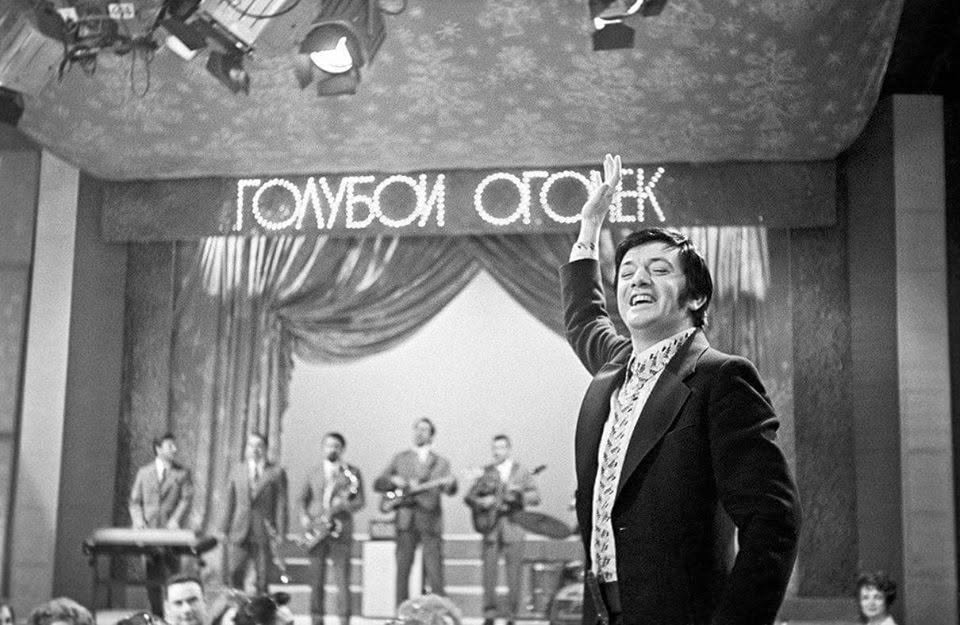
The communist party prioritized producing programming for this growing network. Music, including televised musical specials dedicated to specific singers or bands and regular weekly shows such as Musical Kiosk (Музыкальный киоск), which premiered in 1962 and ran to 1993, played an important part in this. New Year shows, starting with The Little Blue Light (Голубой огонек) in 1962, became a Soviet tradition, playing music and entertainment in the background of family celebrations at home. Often, these popular New Year shows helped introduce new talent (such as a young Larisa Mondrus in 1964-1965). Although The Little Blue Light went off the air in 1987, most major stations in Russia still produce similar holiday programs.
Further, by the 1960s and 70s, a talent pool from state conservatories had been produced. Most estrada stars today still come from classical training, performing with wide if not near-operatic range. Film directors frequently hired professional estrada singers to record songs that actors would lip-sync on screen, allowing productions to feature both accomplished actors and elite vocalists. Well-known examples include Alla Pugacheva’s vocals for The Irony of Fate (Ирония судьбы, или С лёгким паром!) and Aida Vedishcheva’s songs in Prisoner of the Caucasus (Кавказская пленница).
By the 1960s, this pool also allowed for the creation of VIAs and VIOs, full bands that were sometimes used as backup support for traveling estrada singers but also often recorded jazz, folk, funk, blues, and rock of their own.
Estrada singers today rarely accompany themselves on instruments and often perform songs already associated with other artists, seeking to create the definitive interpretation of a composer’s work. Their concerts combine music with elaborate costumes, choreography, comedy, storytelling, and guest performers, reflecting the genre’s roots in variety theater. Many of the genre’s stars are today aging and continually trying to reinvent themselves by collaborating with more modern artists in mixed-genre collaborations with rap, R&B, and even heavy metal influences.
Muslim Magomayev
Biography by Savannah Abbey
Muslim Magomayev was literally one of the biggest voices in Soviet music in the 1960s and 1970s. Born in 1942 in Baku, his father designed theater sets, his mother was a distinguished actress, and his grandfather, for whom Magomayev was named, is considered the founder of Azerbaijani opera. Magomayev studied music from a young age, eventually graduating as a vocalist from Baku Conservatory.
He first gained fame at the Youth Festival in Helsinki in 1963 and then at the Days of Azerbaijani Culture in Moscow where he sang popular songs and operatic arias. He was 19 years old at the time and was immediately invited to perform at the Moscow Tchaikovsky Concert Hall and, from 1964 to 1965, to perform at La Scala in Milan, Italy. He then joined Azerbaijan State Academic Opera and Ballet Theater as a featured soloist where he took particular pride in performing Azerbaijani operas such as Koroghlu, composed by his friend, Uzeyir Hajibeyov, and Shah Ismayil, which was composed by his grandfather.
In 1966, he turned down a position with the Moscow Bolshoi Theater, and instead veered towards estrada. With his powerful voice, charismatic stage presence, and striking personal appearance that stemmed from his Chechen-Tatar-Circassian-Turkish-Russian heritage, he quickly became a heart throb. His first hits included the up-beat 1964 tunes, “The Best City on Earth” (“Лучший город Земли”), which celebrates Moscow, and “Smile” (“Улыбнись”). He followed these with 1967’s swooning “Call Me” (“Позови меня“), and 1969’s moody “Devil’s Wheel” (“Чертово колесо”).
Although Magomayev was not Azerbaijani by blood, he and his family had lived and worked in Azerbaijan for at least four generations and had become well-documented champions of the Azerbaijani language and culture. Magomayev identified strongly as Azerbaijani, often saying that “Azerbaijan is my father and Russia is my mother.” He spoke, sang, and created in both languages.
His greatest hit, “Blue Eternity” (“Синяя вечность”), was released in 1969. The song is about the sea, and Magomayev sings dreamily of distant horizons and the romantic pull of the expansive ocean. The song’s popularity lives on across the former USSR, with recent covers by Enim, one of Azerbaijan’s biggest contemporary artists, and many others.
Also in 1969, Magomayev, with album sales over 4.5 million, received a Midem Gold Disc Award in Cannes, solidifying him not just as a Soviet star, but also as an international talent. Magomayev toured extensively throughout Europe and the U.S.
By 1971, a one hour film documentary, Muslim Magomaev Sings (Поёт Муслим Магомаев) was filmed for TV presentation. It gives equal time to his operatic and popular works with several cinematically filmed clips, including from his performance as Mephistopheles in Faust and his popular “The Little Sailor” (“O Marenariello“), sung in Italian.
“Melody” (“Мелодия“), released in 1972, is widely considered to be one of the great Soviet love songs, exploring the experience of lost love and the desire to recover it. He also soon began recording in other languages, with Bella, ciao! In Italian and a rendition of African-American spiritual song “Down by the Riverside” in English. In 1973, at just 31, Magomayev was awarded the USSR’s most prestigious artistic accolade: People’s Artist of the USSR. He was later appointed to the Supreme Soviet of Azerbaijan.
He continued to release new music through the 80s and 90s. Major songs of his later era included his version of “The Cranes” (“Журавли”) a much older song that he put his own spin on, “Eulogy” (“Элегия”), based on a poem by Nikolai Николай Добронравов, and “Nocturne” (“Ноктюрн”). His last recorded song was, perhaps appropriately, Farewell, Baku (“Прощай, Баку”), recorded in 2007.
Magomayev gradually moved away from being personally on stage, settling into composing for Azerbaijani films. Some of his major projects included, The Legend of Silver Lake (Легенда Серебряного озера; 1984), Sabotage (Диверсия; 1989), and What a Wonderful World (Как прекрасен этот мир; 1999).
He also starred in a series of television specials called Visiting Muslim Magomayev (В гостях у Муслима Магомаева) in which he interviewed and discussed some of, what he felt, were the biggest names in music.
Magomayev officially retired in 1998, although he still performed an occasional concert. He wrote a memoir titled Melody, My Love (Любовь моя — мелодия). He passed away in 2008 from a heart attack and is buried in the Alley of Honor in Baku, next to his grandfather.
Anna German
Biography by Anita Maksimiuk
Anna German lived a short but highly international life, rising to become a defining voice of popular music in much of the Communist Bloc and Western Europe in the 1960s and 1970s. Born in 1936 in the then-Uzbek SSR to a German-Dutch-Russian family, she lost her father to Stalin’s purges. She and her mother then moved often, living in Siberia, Kazakhstan, and eventually Poland following her mother’s marriage to a Polish military officer. Anna was 10 at the time.
Later, she majored in geology at the University of Wrocław, where she discovered her passion for singing at the Kalambur Student Theatre. A number of local estrada composers and theaters then discovered her and helped develop her raw talent.
In 1963, she won second place in Sopot’s International Song Festival for “I’m Having Such a Hard Time With This” (“Tak mi z tym źle“) and, in 1964, swept the Opal Song Festival with “Dancing Eurydices” (“Tańczące Eurydyki“). Both songs remained lasting hits.
Her career skyrocketed in 1964. After recording her first Polish-language release, “To the Other Shore” (“Na tamten brzeg“), she was chosen to represent Poland in a cultural exchange tour in the USSR. There, she recorded her first Russian-language single, “Don’t Hurry” (“Не спеши”), which would set the stage for her rise to super-stardom in Russia. Soon after, she was also chosen for tours of the US and England, for which she prepared songs in English such as Gershwin’s “The Man I Love.” A natural polyglot, she sang in nine languages, with a considerable number of other English and Spanish songs in her repertoire.
In 1965, her first Russian-language album, Sunny Day (Солнечный день) and full Polish-language album, Dancing Eurydices (Tańczące Eurydyki) were released to considerable acclaim. The latter included “Return to Sorrento” (“Torna a Surriento”), a popular Italian hit sung in English and Italian. She had studied abroad in Italy while in college and mastered the language there. This song helped lead to a three-year contract, signed in 1966, to record and perform in Italy, making her one of the only artists to work on both sides of the “iron curtain.”
She soon released Classics of Neapolitan Music (I classici della musica napoletana), competed in music festivals and made television and radio appearances in Italy. Her time abroad also raised her mystique and popularity in both Poland and the USSR. However, tragedy struck in 1967, when a car crash put her in a coma for a week with a fractured spine. She spent months in a cast and re-learning basic movement.
While convalescing, she worked on an autobiographical account of her time in Italy, titled Return to Sorrento?, published in 1969. She also composed music to the poetry of Polish poet Alina Nowak, creating songs eventually released on her comeback and most popular Polish-language album Human Fate (Człowieczy los). The title track was, in particular, a lasting hit. Poland’s Kultura television station celebrated her return with a half-hour documentary about the making of the album.
Aside from time off to give birth to her son, German kept a busy schedule after her recovery. Her tours would take her across the USSR, the USA, and Europe. In 1973, she recorded “A Single Moment Was Enough” (“Jedna chwila wystarczyła”), a hit released as a single but later included on many other compilations.
In 1974, she recorded “Hope,” (“Надежда”), a major hit that ponders love, fate, and the importance of faith. It was first featured on her 1975 self-titled Russian-language album.
Another calling card song, “Greek Wine” (“Greckie Wino”) was originally released as a single and audio postcard in 1975, intended as a vacationers’ anthem. The same year she recorded “And I Like Him” (“А он мне нравится“), a flirty and highly Jewish-influenced tune that would be featured on her 1977 album When the Orchards Were in Bloom (Когда цвели сады).
1977 saw the recording of her singularly most popular song, “The Echo of Love” (Эхо любви), a duet with singer Lev Leschenko that is still covered by young romantics on YouTube. In 1978, she recorded “Think About Me” (“Pomyśl o mnie”), which would be her last Polish-language hit.
In 1979 she lost consciousness during a stay in Moscow and was eventually hospitalized in 1980. She continued to perform and tour despite worsening health until she passed away in 1982, at the age of 46, of bone cancer. In total, she created five Russian language albums and seven Polish language albums as well as dozens of singles and other releases in her lifetime. She is buried in Warsaw’s Reformed Protestant Cemetery.
Anna German is remembered as one of the great singers of both Poland and Russia. In 2012, a popular Russian-language biopic television miniseries was produced by Star Media, a Ukrainian media company that would eventually air in Russia, Ukraine, Poland, Spain, and other countries. Compilations of her work, including hits, live recordings, rare tracks, and by specific language have been released regularly to the present day. She is also remembered by the Anna German International Song Festival, hosted regularly in Poland.
Lev Leshchenko
Biography by Claire Waggoner
Lev Leshchenko is known for his soft, voluminous baritone voice and especially for his performances of patriotic songs. His style blends influences from jazz, military marches, musical theater, disco, and, in more recent work, rock. Now in his 80s, he continues to release new music and pursue artistic collaborations.
Born in Moscow in 1942 to a military family, Leshchenko spent much of his childhood singing in choirs and moving between relatives in Ukraine and his hometown. After a year of service in the Soviet army, he joined the Soviet Red Army Ensemble in 1962, performing with the USSR’s premier military choir until his decommissioning in 1964. That same year, he was admitted to the prestigious GITIS Russian Institute of Theater Arts, where he studied musical comedy.
In 1966, while still studying, he joined the Moscow Operetta Theater where he performed for several years. In 1970 he won the All-Union Estrada Artists competition with a standout performance of “Ballad of Colors” (“Баллада о красках”). He then became a solo vocalist for All-Union Radio and released his first EP in 1971, Don’t Cry, My Little Girl (Не Плачь, Девчонка). In 1972 he won the Sopot International Festival with the song “For That Guy” (“За того парня”). In 1974, he recorded a half-hour television special, Lev Leshchenko Sings (Поёт Лев Лещенко) to promote his first album, Lev Leshchenko (Лев Лещенко).
In 1975, Levshchenko took a major risk by singing “Victory Day” (“День победы”) on live television. Although celebrating Soviet success in World War 2, the song had been judged “frivolous” and “bourgeois” by Soviet censors and shelved. Leshchenko’s rendition, however, turned the song into an instant cultural phenomenon. It remains by far his best-known hit.
Still a relatively young singer, he scored a major hit with a duet with Anna German, then one of the USSR’s most popular artists, with “Echo of Love” (“Эхо любви“) in 1977. It was later nominated for Song of the Year.
In 1978, he sang “Earth’s Gravity” (“Притяжение земли”), the soaring theme song for the Soviet space documentary Ordinary Universe (Обычный космос). It would also be shortlisted for Song of the Year and remain an enduring hit.
In 1980, his place as a pop culture icon continued to solidify when he was chosen to perform “Goodbye, Moscow” (“До свиданья, Москва”), a song specifically written to close out the 1980 Summer Olympic Games in Moscow. Later that year, he released an album titled Earth’s Gravity (Притяжение земли) which additionally featured the hits “Native Land” (“Родная земля”), a very opera influenced song, as well as the disco-esque “Not A Minute’s Peace” (“Ни минуты покоя”).
Between 1974 and 2018, Levshchenko would release an album every 1-3 years, on average, and has been a fixture on Russian-language TV since the start of his career. His 2018 “semi-retirement,” at age 76, still saw him record new music and host three seasons of The Voice 60+ (Голос 60+), a talent contest for seniors.
His impact on the music industry has been extensive. In the 1980s and 1990s, he taught at the pop and jazz singing department of the Gnessin State Music and Pedagogical Institute. In 1990 he also founded a talent studio called Musical Agency, which helped a number of young stars, many of them former students of his, rise to fame.
In 2020, Leshchenko was diagnosed with coronavirus-related pneumonia, placing him in intensive care. Rumors of heart conditions and metabolic disorders have since been heard in tabloids. However, he remains active. He continues to appear on TV in everything from New Year Shows, to daytime talk shows, to even the youth-centered hit show Comedy Club (Камеди Клаб). In 2025, he released his first new album in seven years, Only In Love (Только в любви). Its new music is still recognizably estrada, but also with considerable rock and R&B influence rejuvenating it. The opening hit, “Good Morning” (“Доброго утра”), seems styled as a rock ballad. Meanwhile, the new collaborative duets with artists much younger than he: Zara, Alexey Vorobyov, Alexandra Vorobyova, and Elena Gusarova bring in more modern pop and R&B influences.
His most surprising recent collaboration has been with the band Therr Maitz, best known for indie rock and acid jazz. Their highly creative, orchestral remake of “Good Night” (“Спокойная ночь”), a song originally sung by the classic rock band Kino, has gone viral online.
A considerable part of his image is based on his defying expectations of aging and showing what a healthy, active lifestyle can achieve.
Leshchenko has received some of Russia’s highest cultural honors from both the Soviet and Russian states as well as individual Russian regions. A committed patriot and member of the ruling United Russia party, he publicly supported the annexation of Crimea. Since the start of the war, he has performed for troops while, however, largely avoiding public commentary on the conflict or on artists who left Russia because of it. He has been sanctioned by Ukraine and Canada.
Mikhail Boyarsky
Biography by Josh Wilson
Mikhail Boyarsky’s careers as an actor and singer have always been inseparable. Best known for playing romantic and comedic heroes, he combines an expressive stage presence with a remarkably versatile and distinctive voice, with ever-varying amounts of Vladimir-Vysotsky-like gravel to Bob-Dylan-esque nasality, to smooth, melodic crooning.
Born in 1949 in Leningrad (now St. Petersburg), Boyarsky grew up in a family of actors in a cramped communal apartment. After graduating from the Leningrad State Institute of Theater, Music, and Cinematography, he began performing on stage. His first success came as the lead in The Troubadour and His Friends (Трубадур и его друзья), a musical adaptation of The Bremen Town Musicians inspired by the popular Soviet animated film.
Boyarsky made his film debut in the 1973 wartime drama Bridges (Мосты), but found stardom through musicals. His breakthrough came in the 1975 holiday favorite The New Year Adventures of Masha and Vita (Новогодние приключения Маши и Вити), in which he played the villainous Matvey the Cat. Four years later he cemented his status as a national star as d’Artagnan in D’Artagnan and the Three Musketeers (Д’Артаньян и три мушкетёра). Its theme, “The Song of the Muskateers” and several other songs from the film became national hits.
Capitalizing on this, he landed a televised musical special “And I Go” (“А я иду“) in 1979, with strong jazz and disco influences.
His recording career began in earnest in 1983 with the single “City Colors” (“Городские цветы”), although the B-side “Everything Shall Pass” (“Всё пройдёт”), proved the larger hit. Both songs originated in the 1981 musical comedy Where Will He Go! (Куда он денется!), in which Boyarsky starred.
Also that year, a self-titled single for the group VIA Festival, which had provided backing music for the film, featured “Leaves Burn” (“Листья жгут”), which had been recorded for the movie but later cut. This would also become a major hit for Boyarksy. Perhaps ironically, the movie itself has since been largely forgotten, but the music was popular enough to help launch Boyarksy’s singing career.
His first single unrelated to a film, “Big Dipper” (“Большая медведица”), appeared in 1984. Together with its B-side, “A Song about Things” (“Песенка о вещах”) established Boyarsky as estrada singer rather than just a musical actor.
His first full-length album, Discoclub-16 (Дискоклуб-16), followed in 1986 and included the popular song “I’ll Take the Express Train” (“Сяду в скорый поезд”), as well as fan favorites such as “Island of Childhood” (“Остров детства”) and “So We Parted” (“Вот и расстались”).
In 1987 he recorded “Green-Eyed Taxi” (“Зеленоглазое такси”). Ironically, it initially flopped. Audiences initially responded poorly and producers dismissed it as “sleep-inducing,” dropping it from television broadcasts. After repeated fan requests, however, Boyarsky revived it. It eventually earned a Golden Gramophone Award in 2001 and became his signature song.
He continued releasing successful singles, including “Meeting on the Way” (“Встреча в пути”) in 1989 and “Thank You, My Dear!” (“Спасибо, родная!”) in 1991. Both hits would be featured only in various compilations.
During the late 1990s, Boyarsky co-founded the supergroup Silver with several prominent rock musicians, including former Aquarium drummer Pyotr Troshchenkov and guitarist Vladimir Ermolin of Zarok. Despite occasional touring, the band produced only a single Beatles-styled album that failed to generate any major hits.
Boyarksy has remained active, including appearing in concerts with international stars, hosting an intellectual/dramatic show Pub at Boyarsky Court (Трактир Боярский двор), and most recently hosting a season of Voice 60+ (Голос 60+), a talent contest for seniors. In 2007, he reprised his role as d’Artagnan in Return of the Musketeers (Возвращение мушкетеров), the fourth and final installment. He has also been in many supporting roles in film and television, including voicing The Learned Cat in the long-running Russian-language animated film series Ivan and the Great Wolf (Иван Царевич и Серый волк) as well as Gobber the Viking in the Russian-dubbed How to Train Your Dragon franchise.
His recent strong support for Russia’s war in Ukraine has led to his being internationally sanctioned, and limited his activities to Russia. Combined with ongoing health problems—many attributed to decades of smoking—his performances have become increasingly infrequent. His only new song that has seen success in recent decades has been “Хорошего Питера!,” which loosely translates to “Have a great time in St. Petersburg!” and is a heartfelt tribute to his hometown.
Alla Pugacheva
Biography by Anita Maksimiuk
Over a career spanning more than five decades, Alla Pugacheva has amassed hundreds of hit songs, with scores of her performances each attracting over a million views on YouTube. She has also mentored dozens of young artists, advocated for women’s rights, and, more recently, become one of Russia’s most prominent cultural voices opposing the war in Ukraine.
Born in 1949, she grew up in Moscow. Shortly before graduating the prestigious Ippolitov-Ivanov School of Music in 1965, “Robot” (“Робот”) gained radio airplay. However, her breakout came a decade later with “Harlequin” (“Арлекино”), a Russian rendition of an Emil Dimitrov song that won the Grand Prix at Bulgaria’s 1975 Golden Orpheus Festival and sold an estimated 14 million copies worldwide.
She also became the singing voice of the heroine in the classic 1975 film Irony of Fate (Ирония судьбы) before starring in 1978’s The Woman Who Sings (Женщина, которая поёт), whose story closely paralleled her own rise to fame.
The highly narrative, romantic, and dramatic, Mirror of the Soul (Зеркало души), her debut studio album, sold an estimated 10 million copies worldwide. Some of the songs she wrote herself under the pseudonym Boris Gorbonos, including the theme song to her recent movie, “The Woman Who Sings” (“Женщина, которая поёт“). She has gone on to write the music to and, less frequently, the lyrics to many of her own songs, setting her apart from many other estrada singers. That same year, she also scored a hit with the comedic “Song of a First Grader” (“Песня первоклассника“).
The 1980s cemented her status as the Soviet Union’s leading pop singer. Among her biggest hits were the funky “Maestro” (“Маэстро”), the anthem to motherhood “Do You Know What All Will Be” (“А знаешь, все еще будет“), the moody “Iceberg” (“Айсберг“), the bouncing, dance-worthy “Find Me” (“Найти меня”) and a Russian adaption of a popular Latvian song called “Millions of Scarlet Roses” (“Миллион алых роз“) which she reported initially hated but which arguably became her signature song. She continued her film career, for instance, with the 1985 musical Season of Miracles (Сезон чудес), starred in wildly popular televised new year shows such as The Blue Flame (Голубой огонёк) and New Year Attraction (Новогодний аттракцион). She also branched into international crossovers and collaborations, not so successfully with an English-language album Watch Out!, and quite successfully with a multilingual ballad with German rock musician Udo Lindenberg. She also headlined a three-hour charity performance in 1986 outside Chernobyl, singing for the liquidators containing the fallout.
Throughout the 1990s, she continued to adapt her sound to changing musical tastes with hits such as synth-driven “Take Me With You” (Позови меня с собой), one of the biggest hits of the decade, and the soaring “Love Like a Dream” (“Любовь, похожая на сон”), which was dedicated to Philip Kirkorov, with whom she had a whirlwind marriage. Alongside extensive touring, she launched successful business ventures, including a shoe line and perfume, and became known for mentoring young performers. Using her influence to open doors for emerging talent, she helped launch or advance the careers of artists including Sergey Zverev, Alsou, Lyube, and Philip Kirkorov.
Her 2001 album River Tram (Речной трамвайчик) featured several hits, including “Little Daughter” (“Доченька“) and “Don’t Offend Me” (“Не обижай меня“). In 2009, at age sixty, she retired from large-scale touring but continued recording and shifted her focus to television. From 2011 to 2013, she hosted Factor A (Фактор А), Russia’s version of The X Factor that was renamed for her, and oversaw the Gold Star of Alla (Золотая звезда Аллы) Prize, which provided promising young performers with financial support, mentorship, and national exposure. Many of these young singers, including from Kyrgyzstan and Ukraine, went on to successful careers.
She remained highly active, including with ambitious projects such as recording the soundtrack to the 2021 Russian film, Chernobyl. She abruptly left Russia, however, in 2022 with her husband and two children, in protest of the war in Ukraine. She now lives in Bulgaria. She is still giving interviews, however, in which she makes her views known and continues to release music, including the anti-war singles “Kisses of War” (“Поцелуи войны“) and “Mother” (“Мама“), both released in 2025.
Valery Leontiev
Biography by Lev Kraus
The glamorous Valery Leontiev had a career that skyrocketed through the 80s and 90s. He produced over 20 studio albums and performed for more than half a century before retiring.
Born in 1949 in a remote village in northern Russia, Leontiev showed an early interest in performing. After high school he worked a variety of jobs from brickmaker to postman and tailor, and briefly attended the Leningrad Mining Institute while pursuing music through amateur theater and choirs. His breakthrough came after winning Syktyvkar’s regional Song-72 (Песня-72) competition. He would then join the local philharmonic as a pop soloist.
Further victories followed, including the 1979 All-Union song competition in Yalta and Bulgaria’s prestigious Golden Orpheus Festival in 1980. Although audiences embraced his theatrical style, Soviet cultural officials were initially less enthusiastic about his flamboyant costumes and energetic disco dancing. Official acceptance finally came with his breakout hit, “Flight on a Hang Glider” (“Полет на дельтаплане”), which led his 1983 debut album Muse (Муза).
Leontiev would continue to produce a string of regular hits including the catchy, danceable “Green Light” (“Зелёный свет”) in 1984, the lyrical ballad “Gone Were the Sunny Days” (“Исчезли солнечные дни”) 1985, and a 1986 duet with Latvian actress Lyme Vajkule called “Vernissage” (“Вернисаж”). Originally part of a televised New Year’s production, it became one of his most popular hits.
He would spend considerable time in the later half of decade touring, including to Czechoslovakia, Bulgaria, and India. He also began to be featured in mostly small, musically-oriented acting roles, such as in the films Do Not Marry, Girls (Не ходите, девки, замуж) in 1985 and How to Become a Star (Как стать звездой) in 1986. A major exception to this was his starring role in the rock-opera Giordano (Джордано), where he played three of the main characters.
In 1989, Leontiev released “Margarita” (“Маргарита”), which would become one of the biggest dance club hits of the late Perestroika era. Throughout the 1990s, he toured Canada, the United States, Germany, and Israel. He also continued to release hits such as the sentimental “Don’t You Forget About Me” (“Ты меня не забывай”) and “Casanova” (“Казанова”), a romantic beat released in 1994 about a sultry, handsome stranger arriving at a carnival. In 1996, he received the title of the People’s Artist of Russia.
Leontiev’s elaborate stage productions became increasingly ambitious during the 1990s. He worked closely with Alla Dukhova’s Todes Ballet, whose blend of classical ballet and street dance became a hallmark of his concerts, before establishing his own troupe, Dangerous Liaisons. For a time, he even designed many of the costumes worn by himself and his dancers.
Throughout the later 90s and early 2000s, Leontiv continued to create hits with, for instance, “Treasures of the Black Sea” (“Сокровища Черного моря“) in 1997, and
“Homeless Love” (“Бездомная любовь”) in 1998. He also started the 2000s strong with several reasonably strong hits like “Augustine” (“Августин“), “One Ticket” (“Один билет“), and “Night Call” (“Ночной звонок”).
Throughout the 1990s, he split his time between Moscow and Florida, where he eventually purchased property in 2002. After this date, his hits considerably taper off, although he would produce new music and remain a regular staple of Russian television programs throughout the 2000s and 2010s. In 2009 and 2014, he was decorated with the Order of Honor and the Order of Friendship, respectively.
His final studio album, I’ll Be Back (Я вернусь), released in 2019, featured the dance-oriented style that had defined his career, including the popular single “On the Wings of Love” (“На крыльях любви”). He largely stopped touring in 2020 and officially retired in 2024 at the age of seventy-five.
Larisa Dolina
Biography by Anita Maksimiuk
Larisa Dolina is known for her signature vocal blend of jazz and pop. Born in Baku, Azerbaijan, to a Jewish family in 1955, Dolina grew up in Odessa. There, she studied cello and later joined the We are Odessites (Мы одесситы) orchestra. Later she sang for the state orchestras of both Armenia and Azerbaijan, which included singing heavily modernized Armenian folk songs. Today, she is best known for powerfully singing songs centered on romance, scorn, hidden emotions, and, especially, taking life by the reins.
The singer began her film career in the 1978 film An Ordinary Miracle (Обыкновенное чудо), providing the singing voice for the character Emilia, played by Yekaterina Vasilyeva. In 1981, Dolina toured the USSR with Weyland Rodd Jr., a black Soviet jazz singer whose American father had emigrated to the USSR and become an actor. In 1982, she recorded the folksy, upbeat, and energetic “Three White Horses” (“Три белых коня”), for Magicians (Чародеи), a now-legendary Soviet romantic comedy. She also provided vocals for cartoons, but was largely kept to small or off-screen roles. One of her few substantial onscreen performances was in the 1983 We’re From Jazz (Мы из джаза), in which she portrayed an English-speaking Cuban jazz singer in blackface.
Her first full studio album, titled “A Long Jump” (“Затяжной прыжок”) was released in 1986, based off a stage program she had self produced and directed over the previous year. Its title track, about leaping into the future as from an airplane, leans heavily into jazz piano and saxophone.
While she has released a total of nineteen studio albums, most of her work has focused on true estrada: either televised or stage-performed variety shows. Dolina spent the 1990’s touring Russia, Europe and the U.S. as the leader of various concert programs. She has also altered her style as musical tastes have shifted, experimenting with a wide variety of styles. For instance, the 1990 hit “Forgive Me” (“Прости меня“) is styled as an electronic pop ballad. It went on to be the title song of an album released in 1993.
Meanwhile, one of her best-known hits, “The Weather at Home” (“Погода в доме”) recorded in 1997, is much closer to Russian shanson, with significant jazz influence. The bouncing, powerful song dances around the nuances of a domestic relationship using moody weather as a metaphor. It was the title song of a related album which sold 1.5 million copies.
Her range has also been shown in many collaborations. For instance, in 2020, she recorded “Dripping” (“Капнут”) with Russian R&B artist Burito. She sang “I Will Survive” with Gloria Gaynor in English for a New Year variety show in 2021. For New Year’s 2024, she sang “Street of Roses” (“Улица роз“) with the heavy metal band Aria. She has also been cast in several musicals such as Love and Espionage (Любовь и шпионаж) in 2010 and the female lead in Sweeny Todd in 2022.
Dolina recorded two fully English-language albums: Hollywood Mood in 2008 and Route 55 in 2010. Her most recent release is the Russian-language Be With Me (Будь со мной) from 2025.
Dolina is also a constant fixture on Russian TV and pop culture, participating year in New Year programs, on song contests, both participating and as a judge, and even cooking shows. She recently celebrated her 70th birthday with a nationally televised two-hour concert. She was also recently the center of scandal when fraudsters, posing as law enforcement officers, convinced her to sell her apartment and transfer her personal funds to accounts controlled by criminals. Not uncommon in Russia, the instance became well known enough that it is now sometimes referred to as the “Dolina Scheme.”
Larisa Dolina is also well known as a personal friend to and staunch supporter of president Vladimir Putin. She has strongly and publicly supported Russia’s war in Ukraine and performed numerous times for troops operating near the front lines. She has been sanctioned personally by Ukraine, Canada, and the EU for her actions. In Russia, she has received both the Honored and People’s Artist awards In 1993 and 1998, respectively.
Philipp Kirkorov
Biography by Claire Waggoner
Philipp Kirkorov has been an endlessly energetic presence in Russian popular culture for nearly 40 years. He has created hits not only for himself, but also written and produced them for others, taking in a manic array of influences. He is also known for his flamboyant style and falsetto range, constantly displayed in televised concerts and song contests.
Born in 1967 in Bulgaria to a famed Armenian singer and a French-Russian circus performer, Kirkorov first appeared on TV in 1985 on the variety show Wider Circle. He went on tour with the Leningrad Music Hall to Berlin in 1987, all before graduating from the “star factory” Gnessin State Musical College in Moscow in 1988.
He went on to tour with Alla Pugachova in Australia and Germany and, in 1990, won the ‘Shlyager-90’ (Шлягер-90) competition with the song “Heaven and Earth” (“Небо и земля”). He released his first album the same year, titled Philipp (Филип), featuring the Spanish-influenced “Carmen” (“Кармен”) and “Don’t You Look at Your Watch,” (“Не смотри ты на часы”) which mixes classic rock and electronic influences.
He followed this in 1991 with two more albums: You, you, you (Ты, ты, ты) and Heaven and Earth (Небо и земля). By the end of the year, he had enough wildly popular hits to be tapped for a two-hour televised concert. During this time, “Atlantis” (“Атлантида”) was also first recorded, but was not included on an album until 1992’s So-and-so (Такой-сякой) as Kirkorov reportedly thought the song was “snot-covered sugar.” However, it proved to be his break-out hit, taking him to super-stardom.
Kirkorov represented Russia at Eurovision in 1995 with the song “Lullaby for a Volcano” (“Колыбельная для вулкана”). Despite taking a disappointing 17th place, it marked the start of his prolific Eurovision participation as a composer, producer, and stage director for multiple countries. His most notable entry, “Shady Lady,” earned Ukraine’s Ani Lorak second place in 2008 and Kirkorov the title of People’s Artist of Ukraine. His title was stripped in 2023 due to his open support of Russia’s annexation of Crimea in 2014 and invasion of Ukraine in 2022. Kirkorov is also a People’s Artist of Moldova and People’s Artist of the Russian Federation, in part because of his work with Eurovision artists for those countries.
His 2003 Strangers (Незнакомка) features the ballad “Cruel Love” (“Жестокая любовь”) and the popular duet with Masha Rasputina “Rose Tea” (“Роза чайная”). In 2006 he released a duet with Alla Pugacheva following their divorce in 2005 titled “Cold in the City” (“Холодно в городе”), an upbeat pop track that helped clarify that the two had separated amicably.
Kirkorov is also known for collaborations such as the 2017 “The Last Spring” (“Последняя весна“) with Timati, and two hits in 2018: “Ibiza” (“Ибиза“) with Nikolai Baskov and “The Color of the Mood is Black” (“Цвет настроения чёрный“) with Egor Kreed.
Kirkorov’s latest albums, including 2020’s massive Romances, parts one and two (Романы, Часть 1, Часть 2) and 2026’s Uno have produced hits like “Romances” (“Романы”) and “Vesuvius” (“Везувий”) with expensively produced music videos, with big name Russian actors and directors participating. He also released “I’ve Been Doing Well for a Long Time” (“Давно всё хорошо“) in February 2026, a ballad that reflects on his career.
Apart from his music, Kirkorov is well known for his TV and film appearances. Though he regularly has cameos in TV shows and films such as the comedy movie “Yolki 10” (Ёлки 10), he is also known for his acting in films such as the Love in the Big City (Любовь в большом городе) movie trilogy and made-for-TV estrada productions such as Evenings on a Farm Near Dikanka (Вечера на хыморе близ Диканьки), based loosely on a book by Nikolai Gogol.
Kirkorov is also a favorite of Russian tabloids for his scandals. He and Alla Pugachova, who is 18 years his elder, married in 1995. They divorced in 2005 after a rocky relationship. He allegedly had his bodyguards attack DDT frontman Yuri Sevchuk in 2002 and a reporter in 2004 after he had had altercations with the victims. The reporter sued and won, and many media outlets boycotted Kirkorov for a time. In 2010 he allegedly attacked a producer of the Golden Gramophone show, though he blamed the incident on undiagnosed mental issues.
Since 2022, he has spoken out in support of Russia’s war in Ukraine. He has visited frontline, performed for troops in military hospitals, and performed several times in Crimea, calling it “one of his favorite Russian places.” He has been sanctioned by Ukraine and banned from entering several European countries in response.
Despite all this, or perhaps in part because of it, Kirkorov’s prolific career continues. He has won several Golden Gramophones and been awarded several Russian state prizes.
Nikolai Baskov
Biography by Claire Waggoner
Nikolai Baskov truly bridges opera and pop. He has produced a dozen studio albums, including classical, traditional Russian estrada, and classical crossover. Most recently, he’s been known for collaborating with young rap artists.
Born in 1976 in Moscow, Nikolai Baskov attended the prestigious Gnessin State Musical College and the Moscow Conservatory. In 1998 he won the All Russian Singers’ Competition. The next year he placed second in the Grand Voce competition in Spain and joined the Bolshoi Theatre as a tenor, where he was particularly praised for his portrayal of Lensky in Tchaikovsky’s Eugene Onegin.
In 2000, he had a major hit with “In Memory of Caruso” (“Памяти карузо”), an operatic crossover song about a dying opera singer that had originally been written in Italian. Its video was featured on MTV Russia and capitalized on Baskov’s classic youth look. That same year, he went on a cross-over concert tour and was invited to perform a popular New Year’s show on Russian TV.
He left the Bolshoi in 2001 to focus on his solo music career. He immediately landed a 2-hour televised special of traditional and classical Russian music that would help land him the title of Honored Artist from the Russian state. He also had a number of early radio hits such as 2001’s “Barrel Organ” (“Шарманка”), 2005’s megahit “The Raspberries are Blooming” (“Цветет малина“), a duet with Ukrainian singer Sofia Rotaru, and starred in a string of big-budget televised New Year musicals from Cinderella (Золушка) in 2001 to The Golden Fish (Золотая рыбка) in 2008.
However, most of his early studio work is not available online, even from his official social media, due to conflicts over streaming rights. His first album is largely available as a concert he gave shortly after its release. You Alone (Тебе одной), his fourth studio album, is the earliest available. Its major hit was the 2007 dance song “You Are Far Away” (“Ты далеко”), a duet with Ukrainian singer Taisiia Povalii. However, even that album online is stitched together from a number of later re-recordings and music videos.
Baskov has since not prioritized producing new albums and instead focused on singles, like 2010’s “All the Flowers” (“Все цветы”) and 2016’s megahit “I Embrace You” (“Обниму тебя”). Baskov has also found considerable success in collaboration such as with “Right to Love” (“Права любовь”) with Russian model Oksana Fedorova in 2009 and 2021’s “Great Love” (“Большая любовь”) with Lyubov Uspenskaya.
In 2018, he released the spiritual pop album I Believe (Верую), which features songs like “I Believe” (“Верую”) and “May I Abide in the Lord Forever” (“Да пребуду в Господе вовек”), both of which are presented with heavy opera influence. He followed this the same year with an English-language album called simply Christmas Songs. It has since been mostly removed from streaming services, with the exception of his over-the-top “White Christmas.” While none of these songs became hits, they were together a passion project for his expression of his conservative christian identity.
He has also released numerous comedic songs such as “Natural Blonde” (“Натуральный блондин”), “Nikolai” (“Николай”) with Russian singer Nataly, and the tyrannosaurus-destroying “Ibiza” (“Ибиза”) with Phillip Kirkorov. Many of these more modern works incorporate techno influences and, in the latest stage of his career, he has been successful in inserting himself into Russia’s rap and R&B scene.
In 2020 Baskov collaborated with TikToker and musician Danya Milokhin on the rap track “Partying Wildly” (“Дико тусим”) and again in 2021 on “Wildly In Love” (“Дико влюблены”). The two songs have proven two of Baskov’s biggest streaming successes. He also participated in reality TV events with rappers like Morgenshtern. His recent releases, such as 2019’s “Heart to Heart” (“Сердце на сердце”) and 2025’s “Let Me Touch your Cheek” (“Дай прикоснуться щекой”) also take considerable style notes from R&B and dance, although they remain firmly within the estrada genre.
Baskov has had a long history of collaborating with Ukrainian artists. After the success “Let Me Go” (“Отпусти меня”), his major hit with Taisiya Povaliy in 2004, he was named a People’s Artist of Ukraine for fostering cultural ties between Russian and Ukraine. That title has since been revoked following his strong support for the Russian invasion of Ukraine.
He continues to tour and perform in Russia and is a constant presence on Russian TV. Since 2021, he has hosted Morning Mail (Утренняя почта), a weekly music program that has aired since 1974 on Russia’s Channel One. He hosts a weekly evening show Duets (Дуэты). His most recent release is the 2026 single “Fog” (“Туманы”), another upbeat, techno-influenced track.
Valeriy Meladze
Biography by Alexandra Rosenthal
Valeriy Meladze is a Russian-Georgian singer who spent most of his early career in Ukraine. He has been a prolific source of Russian-language hits for nearly three decades.
Born in 1965 in the Adjarian ASSR to a family of engineers, Meladze and his brother Konstantin both pursued music while attending college in Ukraine. Their earliest recordings are with Gruppa Dialog, where Valery sung lead lyrics on the band’s two albums, 1991’s In the Middle of the World (Посередине мира), based on the poems of Arseny Tarkovsky, and 1993’s Autumn Cry of the Hawk (Оссеный крик ястерба), based on Joseph Brodsky’s poems.
Meladze performed solo at a 1992 program at Moscow’s Luzhniki Stadium with “Don’t Disturb My Soul, Violin” (“Не тревожь мне душу, скрипка”). The following year, he and Konstin left Gruppa Dialog and Meladze was invited by Alla Pugacheva to perform “Limbo” (“Лимбо”) at her Christmas music festival.
Both of these hits would be on his 1995 solo studio album: Sera (Сэра). All the songs were written and composed by his brother, Konstantin, who continues to write all of Valery’s solo music to this day. As Konstantin Meladze explained in an interview, the brothers were intent on showing the need for human relationships at a time when crime and violence had taken hold of Russian media and society. The album’s many hits included its title track, as well as “Night Before Christmas” (“Ночь накануне Рождества”), and “The Middle of Summer” (“Посредине лета”). “Sera” was named Song of the Year at the 1995 Zvezda Awards and Meladze embarked on a promotional tour across Russia.
His followup, 1996’s The Last Romantic (Последний романтик) was not as wildly successful, but did offer two major hits. The first, “Faith” (“Вера”), tells of traveling on a pre-dawn train and thinking about what might be a lover or a relationship with God, leaning on the double meaning of “Faith.” The second hit, “High Society Girl” (“Девушка из высшего общества”) satirically mourns, in country twang, the loneliness plaguing upper class girls.
Although his appearances at concerts and televised specials remained ubiquitous, his next two albums would comparatively struggle. The Samba of the White Moth (Самба белого мотылька), released 1998, had only its title track as a major hit. The following year, That’s How It Was (Всё так и было) released to relatively little fanfare.
His fifth album, Bliss (Нега), took nearly three years to put together and offers rich instrumentation and the soaring, operatic vocals that would become Meladze’s trademark. The album teems with megahits such as “I Can’t Live Without You” (“Я не могу без тебя”), the blues-influesed “Tequila Love” (“Текила любовь”), and “The Ocean and Three Rivers” (“Океан и три реки”), a collaboration with VIA Gra, a Ukrainian girl group created by Konstantin.
In 2004, Meladze again collaborated with VIA Gra on “There is No More Attraction” (“Притявенья больше нет”), a single that would stay for nine weeks at number one and win numerous awards, including the Golden Gramophone Award, the MTV Russia Awards for Song of the Year and Best Pop Project, and the Muz-TV Award for Bеst Duet. The same year, Meladze also won the Muz-TV Award for Best Male Artist of the Year.
His 2008 Despite (Вопреки) built further upon his success. Both the title track, featured prominently on the Admiral (Адмиралъ) soundtrack, and “Salut, Vera” (“Салют, Вера”), a pop ballad that follows a relationship the singer should leave yet doesn’t, have been streamed millions of times. Another megahit, “Foreigner” (“Иностранец”), explores Meladze’s personally torn identity as Russian-speaking Georgian who, at the time, still lived in Ukraine. He sings of feeling like a “foreigner everywhere,” with elements of traditional Georgian and Ukrainian music supporting him.
After this, Meladze deprioritized full albums in favor of streaming singles, most often with slickly produced videos like those for his 2010 hit “Heaven” (“Небеса”) and 2014’s “Free Flight” (“Свободный полет”), which both star popular Russian actresses as Meladze’s love interests. He has collaborated with Russian boy band MBAND (also created by Konstantin) for 2018’s “Mama, Don’t Worry!” (“Мама, не горюй!”) and with R&B artist Mot for 2019’s “How Many Years” (“Сколько лет”). Also of note are 2015’s “My Brother” (“Мой Брат”), in which he sings with Konstantin, and, in 2026’s “Where You Are” (“Где ты есть”), a love song with his wife, former VIA Gra singer Albina Dzhanabaeva. Lastly, he has helped host many music competitions, including several seasons of The Voice, Kids (Голос. Дети).
With his extensive connections to Ukraine, Meladze was a strong and early critic of the war. He has now relocated to Spain, where he continues to produce music and launch global tours which now do not include Russia.
You’ll Also Love

Lolita Milyavskaya / Лолита Милявская
Lolita Milyavskaya (Лолита Милявская) is a Russian-Ukrainian pop singer and TV host. She often goes by her first name alone. Lolita was born in Mukachevo, Ukraine. Her mother was a singer, and her father was her producer and concert director as well as an orchestra conductor. Lolita began singing informally when she was 10 but […]

Albina Apanaeva / Альбина Апанаева
Albina Apanaeva (Альбина Апанаева in Russian) is a Tatar singer. She performs pop music in the Tatar language, and occasionally in Russian. She also currently works as an event organizer, though she’s best known as a singer—she’s sometimes even called the most popular Tatar pop singer. Apanaeva was born in Naberezhnye Chelny (Яр Чаллы in […]

Feruza Jumaniyozova
Feruza Jumaniyozova is an Uzbek singer. She has released songs in Tajik, Uyghur, Farsi, Dari, Turkmen, Azeri, Hindi, Turkish, and Uzbek. Feruza was born on 14 Feebruary, 1984 in Khorezm, in the Uzbek SSR. She started performing music when she was three. Originally wanting to be a doctor, she enrolled in the Institute of Medicine […]

Artur Pirozhkov / Артур Пирожков
Artur Pirozhkov (Артур Пирожков) is a stage name—one of many—for entertainer Aleksandr Vladimirovich Revva (Александр Владимирович Ревва). Of Estonian ancestry, his family immigrated to Donetsk, Ukraine, where their last name was eventually Slavicized to Revva (from Erwa). His father, a renowned mathematician and professor in Donetsk, and his mother separated when he was fairly young. He […]

Yulia Rutskaya / Юлия Руцкая
Yulia Rutskaya (Юлия Руцкая) is a Russian-Kyrgyz pop singer, television host, and model who sings in Russian, Belarusian, and Kyrgyz. Originally from Vitebsk, Belarus, her family moved to Kyrgyzstan when she was five. She is a member of the significant Belarusian diaspora in Kyrgyzstan and has embraced her Kyrgyz side, singing in Kyrgyz at least […]

